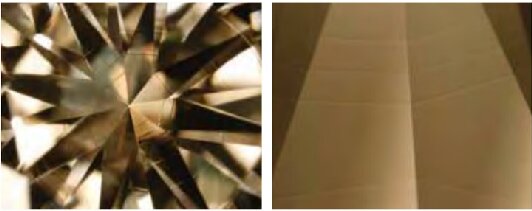
The Moussaieff Red Diamond is a breathtaking Fancy Red gem, widely regarded as one of the world’s largest and finest red diamonds with an iconic legendary standing across gemology and the global jewelry trade.
Unearthed as a 13.9-carat rough stone from a Brazilian mine in the 1990s, the raw crystal was meticulously cut and polished by William Goldberg Diamond Corp., refined down to a finished 5.11-carat gem originally named the Red Shield Diamond before being acquired by London-based luxury jeweler Moussaieff Jewellers and renamed after the brand. Certified by GIA, it boasts top-tier specifications: a coveted Fancy Red color grade—the highest ranking for red diamonds on GIA’s color scale, Internally Flawless (IF) clarity which is exceptionally scarce for colored stones, and a unique modified cushion triangular brilliant cut that optimizes fire and light performance. Pure red is the rarest hue among all fancy colored diamonds, with nearly all natural red specimens weighing under one carat; the Moussaieff Red remains the only known Fancy Red diamond above five carats, its unmatched pairing of Fancy Red and IF clarity a geological miracle linked to extreme mantle pressure and lattice plastic deformation deep within the Earth, whose exact color-forming mechanism is still actively researched by gemologists. Never listed for public auction or open market sale and lacking an official fixed price, gem experts value it well above tens of millions of US dollars (valued at roughly $8 million in the early 2000s, with its worth surging alongside the booming colored diamond market in subsequent years), and it has made rare public display appearances at prestigious institutions including the Smithsonian National Museum of Natural History in Washington D.C. and London’s Natural History Museum. More than a precious jewelry piece, this exceptional diamond is an irreplicable masterpiece forged by rare geological forces and masterful human lapidary craftsmanship, standing as an ultimate holy-grail collectible coveted by elite gem collectors worldwide.
Needle inclusions are common features found inside natural diamonds. They get their name for a simple reason. They are thin, elongated crystal formations that look just like tiny sewing needles. These fine, thread-like inclusions form naturally during a diamond’s growth cycle. Minor stress and subtle distortions in the diamond’s crystal lattice create these slender structures.
Some needles are tiny stretched diamond crystals. Others contain trace minerals like rutile. They may also hold small mineral residues left over from the stone’s formation. You cannot spot them with the naked eye. They only become visible under 10x magnification. Under magnification, they show up as thin straight lines, soft curved streaks, or gentle wispy lines. Most needle inclusions are white or transparent. Dark-colored needles do exist, but they are less common.
These inclusions do not affect all diamonds the same way. Their impact depends on four key factors: size, color, quantity, and placement. A single, small, faint needle causes almost no trouble. It is subtle and unnoticeable. It impacts clarity grade, appearance, and light performance very little. It is far less distracting than regular crystal inclusions or dark spots. It barely disrupts the diamond’s light transmission, brilliance, and fire.
The situation changes when needles are large, dark, or grouped together. Dark needles stand out sharply against clear diamond. They create strong visual contrast. Dense clusters of needles can even merge into cloud inclusions or twinning wisps. This noticeably lowers the diamond’s clarity rating. It scatters incoming light unevenly. The stone loses sparkle and visual brightness, which lowers its overall value. Location also matters a lot.
Needles sitting right below the table facet are highly visible. They catch the eye instantly. Needles near the diamond’s girdle stay hidden and unobtrusive.
Overall, needle inclusions are minor natural flaws in most cases. Scattered, tiny needles are harmless to diamond quality. They cannot be seen without tools. Interestingly, these unique internal marks are not always a downside. They give every diamond one-of-a-kind character. They act as natural proof of the stone’s genuine, unlab-grown formation.
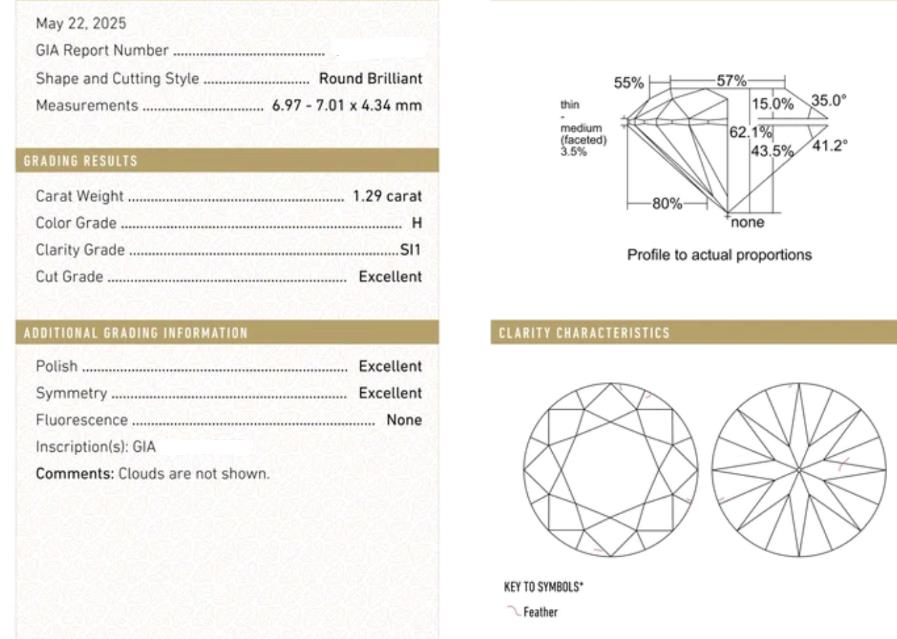
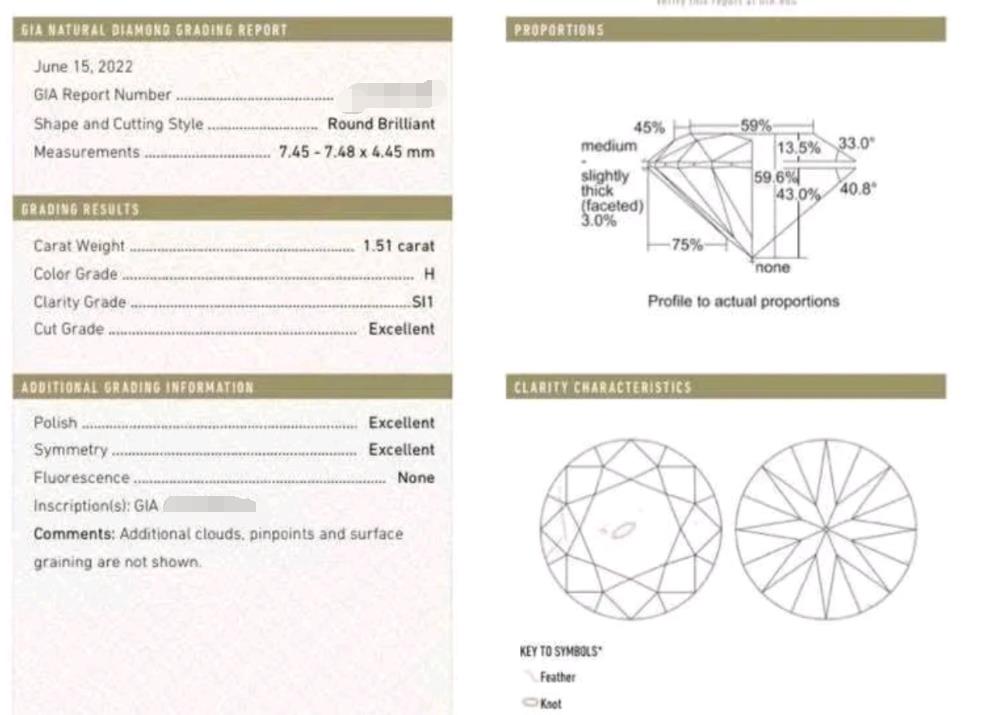
Diamonds are the hardest natural substance on Earth. Still, they are rarely perfect. Completely flawless diamonds are extremely rare. Nearly all natural diamonds carry some kind of imperfections. These flaws fall into two main groups: internal features called inclusions, and surface marks known as blemishes. Learning about them is essential to understand diamond clarity grading. Collectively, they are referred to as clarity characteristics, which serve as the core standard to judge a diamond’s clarity grade.
Inclusions vs Blemishes
Inclusions are flaws inside a diamond. They formed deep underground under extreme heat and pressure while the diamond was crystallizing. These natural traces act like unique fingerprints, proving a diamond is naturally mined.
Blemishes refer to imperfections on the diamond’s surface. Most of them happen during cutting, polishing or daily wear.
Common Inclusions
Most inclusions can only be seen under 10x magnification. Here are the most typical types.
Crystal
They are tiny mineral crystals trapped inside the diamond. Crystals can be colorless, dark, red or green. Their color, size and position decide their impact. Dark crystals stand out more and hurt clarity and appearance more than pale ones.
Cloud
A cloud is made of countless tiny pinpoint inclusions clustered together. It looks hazy and foggy inside the stone. Large or dense clouds will reduce transparency and lower the clarity grade. Severe clouds can make a diamond look milky.
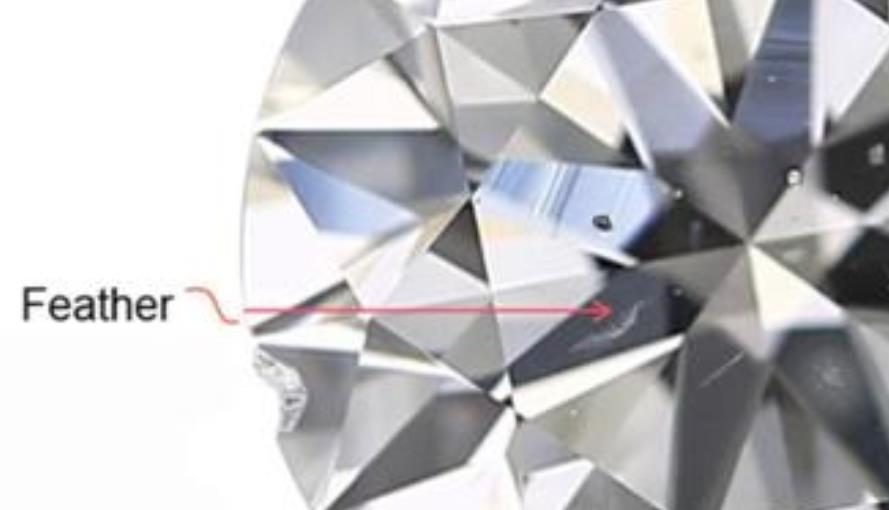
Feather
A feather is an internal crack with a feather-like shape. Small feathers rarely affect durability. But large feathers, those near the girdle or reaching the surface, may cause the diamond to chip or crack if hit.
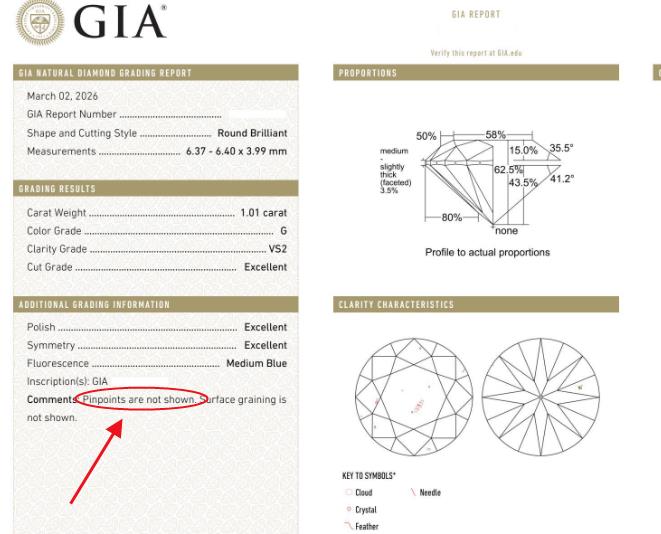
Pinpoint
Pinpoints are tiny white crystal dots. They are one of the most common inclusions. Single or scattered pinpoints barely affect clarity. A large group of pinpoints will form a cloud.
Needles are long, thin and transparent crystal inclusions. Most are colorless. They seldom downgrade clarity unless they are big or numerous.
Twinning Wisp
It is a mix of pinpoints, clouds and small crystals, caused by distorted crystal structure during growth. It often appears as wavy or thread-like lines. Noticeable twinning wisps will bring down the clarity grade.
Common Blemishes
Most surface blemishes can be removed by repolishing. Sometimes a light polish is worthwhile to improve clarity. Yet experts may choose to leave them untouched, to avoid cutting down the diamond’s carat weight.
Extra Facet
It is an extra polished facet, usually made to remove a small inclusion near the edge. It is tiny and does not ruin look or durability.
Polish Lines
These are fine lines left on facets during polishing. On diamonds with excellent or very good polish, they are only visible under magnification. Poor polish lines will weaken a diamond’s luster.
Scratch
Scratches are thin marks on the surface. Minor scratches have little effect on clarity. Deep scratches can be fixed by repolishing.
Natural
A natural is a piece of the original rough diamond skin, mostly kept on or around the girdle. It is seen as proof of natural origin and is not considered a defect.
Chip
A chip is a small nick on the girdle or facet edges. It is caused by impact during cutting or wearing. Big chips will threaten the diamond’s durability.
Cavity
A cavity is an opening on the surface, left after removing a surface inclusion during polishing. Large cavities hurt clarity and easily collect dirt.
Why Clarity Matters
Clarity is one of the 4Cs that define a diamond’s quality, along with color, cut and carat weight. Graders evaluate clarity based on each flaw’s size, quantity, location, type and visibility.
Location matters greatly. Inclusions right below the table are much easier to spot than those near the girdle. The type of flaw tells its nature and potential risk to the diamond structure. Relief means the contrast between an inclusion and the surrounding diamond. Dark inclusions always show more clearly.
Authorities like GIA examine diamonds strictly under 10x magnification. They assign grades ranging from Flawless (FL) to Included (I3).
Inclusions and blemishes record a diamond’s long formation history underground. They are not always drawbacks. They are natural marks of a genuine diamond. It is not practical to chase a totally flawless diamond, for they are extremely rare and costly. A wise choice is to pick an eye-clean diamond — flaws cannot be seen by naked eyes, and will not harm beauty or structure. Always check official certificates such as GIA reports and consult reliable jewelers. In this way, you can fully know a diamond’s clarity features and make a smart purchase.
Not all diamond flaws are created equal. Some inclusions and surface blemishes are completely harmless. They do not affect the diamond’s beauty, brilliance, durability or daily wear. These minor imperfections are totally acceptable and worth buying, allowing you to get a high-quality, eye-clean diamond at a more reasonable price. However, certain critical flaws should never be overlooked. Some inclusions and cracks can impact the diamond’s structural stability, light performance and overall appearance. They may even lower the stone’s long-term value and durability. Many customers feel confused when selecting diamonds. It can be tricky to tell which imperfections are safe and which ones will cause future problems. If you have any doubts or questions during your diamond selection process, do not hesitate to reach out to us. Our professional team is always here to provide you with reliable, expert guidance to help you pick the perfect diamond for your budget and needs.
When people talk about diamonds, most of them will first think of classic colorless diamonds. But nature creates many stunning colored stones too. They are widely know as fancy color diamonds. These colored diamonds are extremely rare and one of a kind. Their value mostly depends on how rare their color is. So which fancy color diamonds are the hardest to find in the world?
First, let’s learn why diamonds get their color. Pure colorless diamonds are made of only carbon. Fancy color diamonds get their hues from small changes during their formation deep underground. There are three main reasons.
First is chemical impurities. For example, nitrogen turns diamonds yellow, and boron creates blue color. Second is structure defects. Twisted crystal lattice can make diamonds pink, red or brown. Third is natural radiation. This special effect forms green diamonds.
The rarest natural fancy color diamond in the world is red diamond. Below is the ranking of top rare colored diamonds, sorted by rarity, with simple explainations.
Extremely Rare:
Red Diamond
Red diamond is the king of all rare diamonds. It is no doubt the rarest one on earth. People still not fully understand how it gets its vivid red color. Most experts believe it is caused by plastic deformation during crystal growth. This tiny defect at atomic level absorbs certain light, and finally shows bright red.
Almost no pure red diamonds exist. Most red stones come with secondary tones, like purple, orange or brown. Only a few pure red diamonds have ever appeared on the open market. The most famous one is the Moussaieff Red, which weights 5.11 carats.
Blue Diamond
We are talking about vivid fancy blue diamonds here. Its color comes from the trace element boron. Boron hardly combines with carbon deep in the earth’s mantle. That is why natural blue diamonds form under very harsh conditions. Two world-famous examples are the Hope Diamond and the 14.62-carat Oppenheimer Blue.
Pink Diamond
Pink diamonds are beautiful and incredibly rare. Different from blue diamonds, their color does not come from impurities. Extreme pressure twists the carbon lattice and causes plastic deformation. This changes how light is absorbed and creates soft pink tones. The Argyle Mine in Australia was once the main source of pink diamonds. It closed in 2020, so pink diamonds become even harder to find today. The 59.60-carat CTF Pink Star is the most iconic pink diamond, and it sold for an amazing price at auction.
Moderately Rare:
Green Diamond
Natural green diamonds get their color from long time exposure to natural radiation. Real fancy vivid green diamonds are super rare. Most green color only stays on the stone’s surface. If cutters remove the colored part during polishing, the diamond will lost most of its value. The 41-carat Dresden Green is the most well-known green diamond.
Purple Diamond
Purple diamonds are unusual and rare. Their color is a mix of plastic deformation and hydrogen impurities. Pure purple diamonds are hard to find. Most have pink or grey overtones.
Orange Diamond
Pure bright orange is also called flame color. It is extremely scarce. The color is formed by both nitrogen and crystal structure flaws. Pure orange diamonds are even rarer than pink ones. Most orange diamonds on market carry brown or yellow shades. The 5.54-carat Pumpkin Diamond is its top representative.
Relatively Rare:
Yellow Diamond
Yellow diamonds are the most common fancy color diamonds. Even so, Fancy Vivid Yellow stones are still rare and valuable. Nitrogen is what gives them yellow color. Pale yellow or brownish yellow diamonds are easy to see. But saturated, bright canary yellow diamonds are worth a fortune. The 128.54-carat Tiffany Yellow Diamond is a world-famous treasure.
The world of diamonds is more than just colorless stones. From deep red to bright blue, every fancy color diamond is a unique miracle made by nature. Leibish is a professional supplier of fancy color diamonds. You can visit there official website to view all kinds of fancy colored diamonds, more review about leibish vist here…
Platinum is a natural white precious metal. It is famous for pure, rare and everlasting features. It is widely seen as the top material for making wedding rings.
Why pick platinum wedding rings? Main advantages
High purity & low allergy risk
Platinum jewelry usual has a purity of 90% to 95%. Common marks are Pt900 or Pt950. The rest parts are mixed with other precious metals to make it harder. Thanks to its high purity, it works great for people with sensitive skin. It hardly cause skin allergies.
Timeless luster
Platinum’s white shine is natural. It will never fade or turn yellow. Over years, the surface may get scratches and wear, which people call patina. But the metal inside stays white all the time. It stand for endless and faithful love.
Strong and durable
Platinum has high density. It is tough and long-lasting. It can hold precious gemstones like diamonds firmly and stop them from falling off. That makes it a perfect choice for engagement rings and wedding bands with diamonds.
Great rarity
Platinum is much rarer than gold. Mining and refining process is also more difficult. So its value is higher than gold. Wearing a platinum ring means you hold a precious promise.
Solid weight
With high density, a platinum ring feel heavier than white gold ring of the same size. You can clearly feel its texture when wearing.
Points you need to know (Disadvantages)
Higher price
Because it is rare and high in purity, platinum rings cost about 1.5 to 2 times more than gold or white gold rings with same weight.
Easy to get scratches
Platinum is relatively soft. It gets tiny scratches more easily during daily wear. But these marks only move the metal surface, not lose material. The weight almost never drop. Many people love these traces left by time.
Soft luster
Compare with shiny white gold, platinum has a mild and elegant matte white glow. If you love super bright shine, you need to polish it more often.
Platinum vs White Gold
Color: Platinum has natural pure white, no discoloration. White gold is originally yellow. It is coated with rhodium to look white. Once the coating wear off, pale yellow will show up and needs re-plating regularly.
Purity: Platinum is high, mostly 95%. White gold is lower, generally 75% gold mixed with other metals.
Wear resistance: Platinum is soft and easy to scratch, no metal loss. White gold is harder and scratch-resistant, but the rhodium layer fades over time.
Weight: Platinum is heavy and solid. White gold is lighter.
Allergy: Platinum causes nearly no allergy. White gold contains nickel, some people will get skin problems.
Price: Platinum is more expensive. White gold costs less.
Maintenance: Platinum just need occasional polishing. White gold needs rhodium re-coating every few years.
Shopping tips
Check stamps carefully. Look for Pt950 or Pt900 inside the ring, they prove real platinum. Choose trusted jewelry brands for good quality and after-sales service. Try the ring on in person, since platinum is heavy. Its strong structure fits complex designs and stone setting well. Simple plain bands also show its gentle luster perfectly. Do make a reasonable budget for platinum rings.
Care & cleaning
Take it off when doing housework or sports. Keep it away from chemicals like bleach, perfume and hair spray. For daily clean, use mild soapy water and a soft brush, then dry it with soft cloth. Send it to jewelry store for professional check, cleaning and polishing every few years. Also check the prongs regularly to keep diamonds safe.
As the world’s largest online diamond and jewelry retailer, Blue Nile mainly operates via e-commerce. It cuts out middlemen and the high rent of physical stores, so customers can enjoy more competitive prices.
Blue Nile currently has no physical shops or showrooms in Hong Kong. All parcels from Blue Nile come with home delivery service. For customers in mainland China or those who cannot receive deliveries easily, diamonds can be shipped to our Hong Kong pickup points for self-collection.
作為全球最大的線上鑽石與珠寶零售商,Blue Nile 的核心商業模式是通過網絡銷售,從而省去中間環節和實體店的高額租金,將其轉化為更具競爭力的價格提供給客戶。
Blue Nile 目前在香港沒有設立傳統的實體門市或專櫃。對來自於blue nile的包裹,快遞都是提供派送入戶服務的。 對於大陸或者接受快遞不方便的顧客,鑽石可以郵寄到香港自提點,然後提貨。
Blue Nile do not have physical showroom in Hong Kong. But Blue Nile offers very convenient options for local customers.
You can visit their official Hong Kong website www.bluenile.com anytime. There are over 600,000 diamonds and a wide range of jewelry here. All diamonds come with GIA, IGI or AGS certificates. After you place a order, goods will be shipped directly from overseas to your address in Hong Kong. Shipping is usual free, and all duties are pre-paid. The whole process is simple and smooth.
Blue Nile also provides great online support. You can reach their team via live chat, email and phone. Their professional diamond and jewelry consultants are ready to give advice. They will help you pick the right diamonds based on your budget and preference.
Here is an important update about showrooms. Blue Nile once ran showrooms in a few cities worldwide, such as New York, Dublin and Seattle. These are not regular retail shops. You cannot buy or take away finished goods on site. Customers need to book an appointment first. With the help of consultants, you can view sample items and select diamonds on computers.
In recent years, Blue Nile has shut down almost all showrooms outside the United States and focus fully on online business. Only showrooms inside the US remain open. For this reason, there is no physical showroom available in Hong Kong right now.
最新情況:截至最近幾年,現在美國境內有展示廳,Blue Nile 已關閉了幾乎所有美國境外的線下展示廳,全面回歸線上模式。因此,目前在香港也沒有此類型的展示廳。
Advice for customers in Hong Kong
Shop online with full peace of mind. Blue Nile enjoy an excellent reputation, and it offers a 30-day return policy. Please check the latest terms for full details. You will have plenty of time to inspect the items after delivery. We suggest you take your diamond to local independent jewelry appraisers in Hong Kong for recheck. This can make sure the stone matches all information on its certificate.
Make good use of the powerful filter tools. The website has detailed filters, including the 4Cs, price, diamond shape and certificate type. You can narrow down your choices easily and find the perfect diamond for you.
Do price comparison for reference. Pick your ideal diamond on Blue Nile and note down its GIA number and 4C details. Then look for diamonds with similar specs at local Hong Kong jewelry shops, such as Chow Tai Fook, Chow Sang Sang and Tse Sui Luen, as well as upstairs stores (
Do price comparison for reference. Pick your ideal diamond on Blue Nile and note down its GIA number and 4C details. Then look for diamonds with similar specs at local Hong Kong jewelry shops, such as Chow Tai Fook, Chow Sang Sang and Tse Sui Luen, as well as upstairs stores (In-building Shop). You will find Blue Nile usual has a big price advantage.
To sum up, Blue Nile do not have physical stores/showrooms in Hong Kong for now.
給香港消費者的建議
安心線上購買:
Blue Nile的信譽極高,提供30天退貨政策(詳情需查看最新條款),這讓您有充足的時間收到貨後進行檢驗。
Moissanite is beautiful jewelry. It has high hardness and great cost performance. But it is not a real diamond. It is not lab-grown diamond either. Moissanite is an excellent diamond simulant and alternative. However, its chemical composition and physical property are totally different from diamond.
Natural moissanite can hardly be found on Earth. The reserve is too small to support the jewelry market. For this reason, all moissanite jewelry sold today are made in lab. Its scientific name is synthetic silicon carbide, or SiC.
Moissanite is a mineral that exist in nature but extremely rare. It was first discovered by Dr. Henri Moissan, a Nobel Prize winner. That is how this stone got its name.
Moissanite VS Lab-Grown Diamond
Here is a clear chart showing their key differences.
Chemical Composition
Moissanite: Silicon Carbide (SiC)
Lab-Grown Diamond: Pure Carbon (C)
This is the biggest difference. They are two completely different substances.
Origin
Moissanite: Lab created. Natural moissanite is almost impossible to find.
Lab-Grown Diamond: Cultivated inside laboratory.
Both are man-made stones, but their materials are not the same.
Hardness (Mohs Scale)
Moissanite: 9.25
Lab-Grown Diamond: 10
Diamond is the hardest natural material in the world. Moissanite ranks second. Both are tough enough for daily wearing.
Refractive Index
Moissanite: 2.65 – 2.69
Lab-Grown Diamond: 2.42
Moissanite has higher refractive index. It produce much stronger fire and rainbow sparkle. It looks brighter than diamond, but the strong flash may look unnatural to some people.
Dispersion
Moissanite: 0.104
Lab-Grown Diamond: 0.044
Moissanite’s dispersion is 2.5 times higher than diamond. This is why it shows such outstanding colorful fire.
Luster
Moissanite: Sub-adamantine luster
Lab-Grown Diamond: Adamantine luster
Professional jeweler can tell them apart by luster. Diamond has sharper and more brilliant shine.
Thermal & Electrical Conductivity
Moissanite: Conduct heat and electricity
Lab-Grown Diamond: Conduct heat
Common diamond tester works by checking heat conductivity. So moissanite will also show “diamond” on basic testers. But professional electric tester can tell the two apart easily.
Price
Moissanite: Much cheaper
Lab-Grown Diamond: Lower than natural diamond, but more expensive than moissanite
A high-quality 1 carat moissanite only cost tens to hundreds of currency units. A 1 carat lab-grown diamond will cost several thousand instead.
To sum up, moissanite is never a type of lab-grown diamond. It is just a high-quality diamond simulant. Lab-grown diamond is real diamond in nature. Both are lab made, but their chemicals and physical traits are fully different.
When you make a purchas, think about your budget, personal needs and how much you value authenticity. Choose the right stone that suit you best.
Fancy color diamonds refer to diamonds with obvious natural body color. Their color must be deep and saturated enough. They go beyond the D-Z color range for colorless diamonds. Their color comes from trace elements or lattice distortion during geological formation. Fancy color diamonds are miracles of nature. Their value mostly lies in their one-of-a-kind hues.
How Fancy Color Diamonds Get Their Color
Here are the main color causes and notes for each type.
Yellow
Cause: Nitrogen atoms.
Note: It is the most common fancy color diamond. People often call it canary yellow.
Blue
Cause: Boron atoms.
Note: Extremely rare. The famous Hope Diamond is a blue diamond.
Pink
Cause: Lattice distortion.
Note: Huge pressure changes the atomic structure. Pink diamonds are rare and high price.
Green
Cause: Natural radiation.
Note: Formed after long time natural radiation. It is very hard to find.
Red
Cause: Lattice distortion plus nitrogen elements.
Note: The rarest color of all. You can barely see red diamonds on the market.
Orange
Cause: Nitrogen elements and lattice distortion.
Note: Pure vivid orange diamonds are extremely scarce.
Purple
Cause: Hydrogen elements and lattice distortion.
Note: Very rare. Most purple diamonds have pink or grey secondary tones.
Brown / Cognac
Cause: Lattice defects or nitrogen elements.
Note: They were mainly used for industrial use in the past. Now they are very popular as fashion jewelry.
Black
Cause: Large amounts of graphite or mineral inclusions.
Note: Opaque stone with a special mysterious look.
Buying Guide for Fancy Color Diamonds
Set your budget first
The price range of fancy color diamonds is extremely wide. You need to know your budget clearly before shopping.
Choose diamonds with official certificates
Only pick fancy color diamonds with certificates from well-known institutes like GIA. A reliable certificate is the base for investment and collection.
Color is the top priority
Spend most of your budget on better color. It is better to choose a diamond with high color grade, such as Fancy Intense or Fancy Vivid. It is okay if it has slightly smaller carat weight or lower clarity.
See the stone in person
Color is a very personal feeling. Two diamonds with the same certificate grade may look different to your eyes. Always check the diamond face to face. If you cannot visit the store, ask for high-definition videos.
Think about the setting metal
The color of ring metal can greatly change how a fancy diamond looks. For example, yellow diamonds show warmer tone when set with rose gold. White gold can better bring out the soft beauty of pink diamonds.
How to Grade Fancy Color Diamonds – The New 4C Standard
Grading rules for fancy color diamonds are different from colorless diamonds. Color takes the leading role. It accounts for about 70 to 80 percent of the total value. People usually call this system “4C + 1C”.
Color – The most important factor
Hue
It means the main color of the diamond, such as pink, blue or yellow. Sometimes a diamond has more than one tone. We call these extra shades secondary colors. For example, pink with purple overtones.
Saturation
This stands for how strong the color is.
Tone
It refers to how light or dark the color appears.
Color Grading Scale
From light to deep, the grades are listed below:
Faint → Very Light → Light → Fancy Light → Fancy → Fancy Dark → Fancy Intense → Fancy Deep → Fancy Vivid
Value Reference
Normally, Fancy Vivid is the highest grade and has the highest value. Next are Fancy Intense and Fancy Deep. You also need to consider how rare the hue is when judging value.
Carat Weight
Just like colorless diamonds, bigger carat size means higher rarity. But for fancy color diamonds, color effect is far more important than carat weight. A small Fancy Vivid diamond can cost much more than a large Fancy Light diamond.
Cut
For fancy diamonds, cutters do not focus only on brilliance anymore. The main goal is to maximize color intensity and beauty. Cutters choose the best shape and proportion according to color distribution on rough stones. Radiant, cushion and emerald cuts are very common choices.
Clarity
Clarity become much less important here. The strong color can easily cover inclusions inside the stone. It is acceptable as long as inclusions do not hurt durability and are not too obvious when viewed from the table. Fancy color diamonds with SI or even I clarity grade are very common on market.
Certificate – The extra 5th C
This part is extremely important. The fancy color diamond market is complicated. Authorized certificate is the only proof to tell natural color apart from color treated stones.
GIA, the Gemological Institute of America, issues the most trusted fancy color diamond reports in the industry. The report writes down full details, including color grade, hue and natural color origin.
Famous Fancy Color Diamonds and Their Value
Red Diamonds
They are the rarest type. The price can reach millions US dollars per carat.
Blue Diamonds & Pink Diamonds
They rank second. They are super stars at diamond auctions and set many record high prices. Famous examples are the Oppenheimer Blue and CTF Pink Star.
Green Diamonds & Orange Diamonds
Extremely rare and carry an ultra-high value.
Yellow Diamonds
They are the most affordable among all fancy color diamonds. Even so, Fancy Vivid Yellow diamonds still cost a lot of money.
Lab-Grown Fancy Color Diamonds
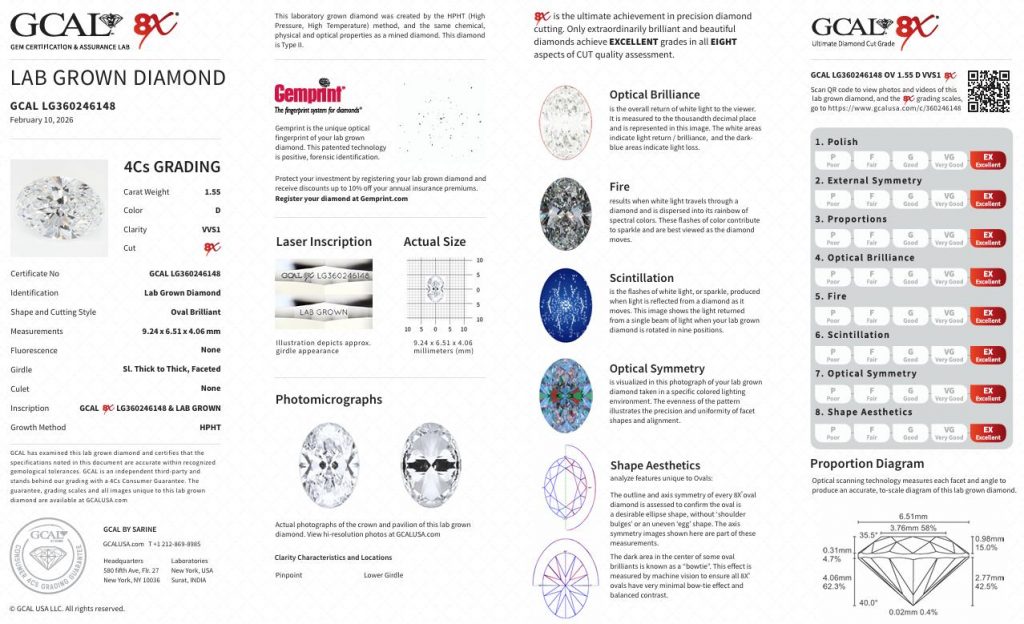
Lab-grown fancy color diamonds are created in laboratories. Scientists use high-tech methods to copy the high temperature and high pressure environment deep in the earth mantle. Another common way is CVD, chemical vapor deposition. These lab made stones have bright natural-looking color. Their physical, chemical and optical properties are exactly the same as natural diamonds.
Their color is not simple dyeing. During the growing process, workers add specific elements or create lattice defects on purpose. The forming principle is basically the same as natural fancy color diamonds.
How Lab-Grown Diamonds Get Their Color (Comparison with Natural Formation)
Yellow
Lab method: Add nitrogen (N) elements during growth.
Natural cause: Also formed by nitrogen elements. Two ways are identical.
Blue
Lab method: Add boron (B) elements during growth.
Natural cause: Blue diamonds form because of boron. The principle matches fully.
Pink, Red, Purple
Lab method: Use electron irradiation and annealing after growth to create lattice distortion, also called plastic deformation. This is a widely accepted treatment.
Natural cause: Lattice distortion under pressure, same core principle.
Green
Lab method: Process with electron irradiation.
Natural cause: Long term natural radiation.
Orange
Lab method: Adjust nitrogen structure or combine with irradiation treatment.
Natural cause: Mix of nitrogen and lattice distortion.
Black
Lab method: Add large amount of graphite or other mineral inclusions.
Natural cause: Natural black diamonds also form with rich inclusions.
Lab-Grown Fancy Color Diamonds VS Natural Fancy Color Diamonds
Price
Lab-grown: Big price advantage. The cost is only a fraction or one tenth of natural ones. More people can afford bright fancy colored diamonds.
Natural: Extremely expensive. Top fancy stones cost hundreds of thousands to millions US dollars per carat.
Rarity
Lab-grown: Mass production is possible. People can make any color and size in theory. Rarity is man-controlled.
Natural: Ultra rare. Especially red, blue and pink diamonds. They are real gifts from nature.
Color Performance
Lab-grown: Rich color choices with high saturation. Labs can produce diamonds with even and deep color which you hardly find in nature.
Natural: Color depends fully on natural conditions. Every stone is unique. High saturation fancy colors are very hard to find.
Environment & Ethics
Lab-grown: Most sellers mark them as eco-friendly and conflict-free. But you need to notice the high energy use during production, especially for HPHT method.
Natural: Mining brings environmental impact. There are also ethical concerns. Though the Kimberley Process is running, arguments still exist.
Resale & Preservation Value
Lab-grown: Almost no value retention. The price will drop as technology develop. People buy them mainly for decoration and low cost.
Natural: Great collection and preservation value. Top fancy color diamonds act like hard currency. Their price keep rising in the long run.
Certificate
Lab-grown: Graded by GIA, IGI and other institutes. Certificates clearly mark “Laboratory-Grown”. It also notes if the color is post-growth treated.
Natural: Certificates mark “Natural” and record natural color origin.
The Importance of Authorized Certificates
For lab-grown fancy color diamonds, certificates are even more necessary than natural ones. Color treatment technology is very common now.
GIA (Gemological Institute of America)
It issues detailed grading reports for lab-grown fancy diamonds. The report clearly states three key points:
This is a laboratory-grown diamond.
If the color is made by post-growth treatment (applies to pink, green and similar stones).
Full color grading, such as Fancy Vivid Pink.
IGI (International Gemological Institute)
It is also a mainstream certificate in the market. Its content is similar to GIA reports.
Always buy lab-grown fancy color diamonds with official certificates. These documents can make sure you get the correct product and clear information.
AGS, short for American Gem Society Laboratories, is a highly authoritative diamond grading lab. It is famous all over the industry. When it comes to cut evaluation, AGS runs one of the strictest and most precise systems in the world. AGS is just as well-known as GIA, the Gemological Institute of America. Both are top trusted organizations for issuing diamond certificates. Still, they have different grading focuses and rules.
Core Features: AGS vs GIA
Cut Grade
AGS take cut as its biggest strength. It uses number grades from 0 to 9, and created the well-known “Ideal” cut standard. Its assessment goes far beyond basic proportions. It also includes detailed light performance tests, such as brightness and light leakage. GIA uses descriptive grades: Excellent, Very Good and Good. Its grading system is mature and widely accepted across the market.
Color & Clarity
AGS adopts the same D-Z color scale and FL to I3 clarity scale as GIA. Its strict level is equal to GIA. GIA sets the industry standard for color and clarity, also using D-Z color and FL-I3 clarity grades.
Cut Rating Scale
AGS use a 0-to-10 numeric scale. 0 stands for the highest Ideal grade, while 10 is the lowest. GIA only use word grades like Excellent and Very Good.
Market Popularity
AGS is highly respected among professional jewelers and high-end buyers, especially in North America. But overall, its certificates are less common than GIA. GIA is the most universal certificate worldwide. It is like hard currency in the diamond trade.
Main Focus
AGS put extreme emphasis on cut quality. It aims to pick out diamonds with perfect optical performance. GIA gives balanced grading to all four Cs. It acts as a comprehensive benchmark for the whole industry.
How to Understand AGS Cut Grades
Cut grading is the most valuable part of an AGS certificate. It does not only check diamond proportions. It focuses more on real visual and light effects. AGS has ten cut grades from 0 (Ideal) to 9 (Fair).
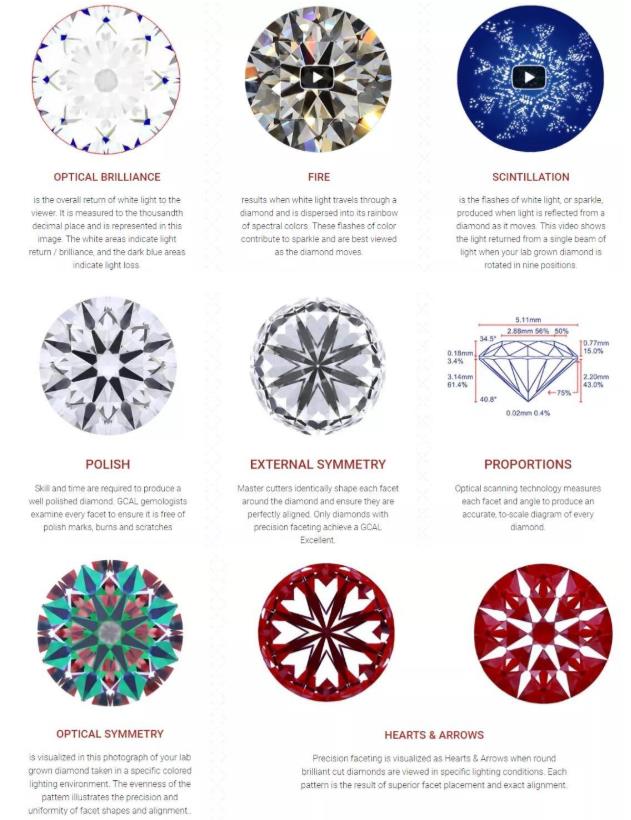
0 (Ideal): This is the top rank. The diamond has perfect proportions, symmetry and polish. Its light performance is outstanding. People always say AGS 0 standard is much harder to reach than GIA Excellent, especially for round brilliant diamonds. Buyers chasing top-tier cut always look for AGS 0.
1 (Excellent): It is still a great cut. Only tiny differences separate it from Grade 0.
2 & 3 (Very Good): Nice cut quality. The stone can reflect most incoming light well.
4 – 7 (Good to Fair): Average cut. You can see obvious light loss on the diamond.
8 – 9 (Poor): Bad cut. Light leaks out from the bottom or sides easily. The diamond looks dull and dim.
AGS Ideal 0 vs GIA Excellent
A diamond can get GIA Excellent and AGS 0 at the same time, but it is not always the case. AGS test more light performance factors, including brightness, fire and scintillation. Some diamonds with GIA Excellent cannot pass AGS 0 rules. AGS Ideal 0 is a higher level, like the best among top students.
Advantages and Disadvantages of AGS Certificates
Advantages
AGS has unbeatable cut evaluation. It is the best reference for people who pursue perfect light performance. Its color and clarity standards are as strict as GIA, so you can fully trust the result. As a reputable professional group, AGS certificates gain great recognition in the trade.
Disadvantages
AGS certificates are not as popular as GIA. If you plan to resell or upgrade your diamond later, it will be less easy to deal with. Diamonds with AGS 0 cut usually cost more. The top cut label makes them have a price premium compared with same 4C diamonds with GIA cert. Besides, its complex cut system mainly works for round brilliant diamonds. For fancy shapes like oval and cushion, AGS cannot show its strong points.
Buying Suggestions
If you care most about sparkle and light performance and have enough budget, AGS Ideal 0 diamond is your best pick. It means the highest guarantee for diamond cut.
For regular customers, GIA Excellent cut is already wonderful. These diamonds shine brightly and balance quality and cost well. You do not need to blindly chase AGS 0, unless you have deep knowledge and strict demands on cut.
No matter which certificate you choose, always check the laser inscription on the diamond. Make sure the number match the code on the certificate to avoid fake goods.
AGS is a professional certificate specially focused on cut. It sets a higher standard for diamond cutting. Diamonds with AGS Ideal 0 are truly top class in optical performance. For most buyers, GIA Excellent is perfect enough and much easier to circulate. Your final choice depends on what you value more: ultimate cut performance, or wide market acceptance and better value for money.
A diamond certificate is like a diamond’s ID card. Blue Nile and James Allen were once two of the world’s top online diamond retailers. Here is a new update: James Allen is now part of Blue Nile. Their diamond inventories have fully combined together. When it comes to diamond documents, the most well-known and reliable ones are from GIA, IGI and AGS. AGS have much stricter rules for diamond cut grading.
GIA Certificate (The Most Important One)
Both Blue Nile and James Allen highly recommend natural diamonds with GIA certificates, especially for stones over 0.5 carats. GIA is the most strict and trusted lab in the jewelry industry. The famous 4C standard for diamonds was created by GIA. Diamonds with GIA papers use unified grading rules. They are easy to compare, and also hold their value better over time.
My shopping advice: No matter where you buy diamonds, always pick those with GIA certificates first. It is the best way to aviod confusion and guarantee real quality.
What is AGS Certificate?
AGS stands for American Gem Society. It is an organization that protect consumers and share professional jewelry knowledge. AGS Laboratories issues official diamond grading reports, known as AGS certificates. This lab earn great fame for its advanced cut grading system. AGS is highly authoritative. Its cut evaluation is widely seen as one of the most precise in the trade. AGS enjoys the same good reputation as GIA, and both are top trusted diamond certificate providers.
IGI Certificate
Both retailers also carry diamonds with IGI certificates. IGI is extremly popular in the lab-grown diamond market, and its standards are widely accepted around the world.
Blue Nile keeps a large stock of natural diamonds with IGI certificates. Customers need to check the certificate type carefully when making choices.
In-house or Other Commercial Certificates
For tiny diamonds below 0.5 carats, or finished set jewelry, both brands may use their own in-house certificates or other commercial papers.
Important warning: You need to be very careful with these diamonds. In-house grading standard are not as strict as GIA or IGI. Grade inflation often happen here. For example, a diamond graded SI2 may be marked as VS. Ordinary buyers can hardly tell the real difference.
Shopping tip: Try your best to stay away from diamonds with only in-house certificates. Only choose them if you fully trust the brand or you have a very tight budget. Stick to GIA or IGI certificates to keep yourself safe.
Visual Technology (Great Helper for Online Shopping)
Both platforms own excellent online video tools. Blue Nile provides 360° high-definition videos for every single diamond. With the free real-time inspection function, you can zoom in, rotate and check every facet closely. You can clearly see the exact position of inclusions and how serious the bow-tie effect is. This experience is almost the same as viewing the diamond in person.
Final Reminder
Always stay alert. Do not buy diamonds that only come with seller’s own certificates, without GIA or IGI reports. New buyers should skip these items, unless the price is really attractive and you are willing to take the risks.