Not all diamonds are worth buying!!!
Both milky tint and brown hue:Tap to see full diamond info
This diamond has milky:Click view detailed diamond information
This diamond has green fluorescence.:View diamond details
This diamond has a cavity:See the diamond details
GIA, the Gemological Institute of America, do issue official certificates for laboratory-grown diamonds. However, these documents are quite different from the certificates for natural diamonds in names, contents and main purposes. It is very important for every buyer to tell them apart clearly. Here is the full and detailed explanation.
GIA Lab-Grown Diamond Report vs GIA Natural Diamond Grading Report
We list the key differences between the two types of certificates below.
Document Name
GIA Laboratory-Grown Diamond Report for man-made diamonds.
GIA Diamond Grading Report for natural diamonds.
Main Purpose
The lab-grown report focus on identification and grading. It confirm the stone is made in lab, and grade its four key factors: color, clarity, cut and carat weight.
The natural diamond report do identification, grading and also act as a guarantee. Besides 4C grades, it proves the diamond is natural and supports its market value.
Key Contents
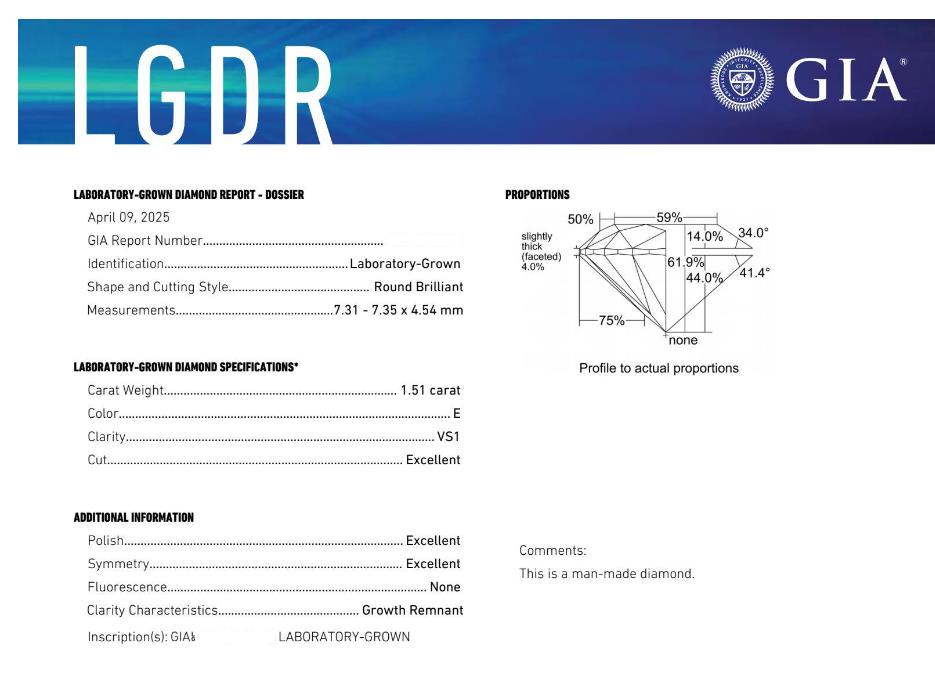
For GIA lab-grown diamond report:
It clearly mark the words “Laboratory-Grown”. It state the production method, either CVD or HPHT. The report includes standard 4C grades, clarity plot, proportion diagram and a QR code. You can scan the code to check the electronic report online.
For GIA natural diamond grading report:
It is marked “Natural Diamond”. It has complete 4C grades, clarity plot and proportion diagram. It also record fluorescence details. Some diamonds have laser engraved GIA code on the girdle, which is optional. A QR code is also printed for online inquiry.
Grading Standards for Color & Clarity
Lab-grown diamonds use the same standard as natural ones. It follow D-Z color scale and FL to I3 clarity scale. Natural diamonds use exactly the same D-Z color grades and FL-I3 clarity grades too.
Most Obvious Differences
The lab-grown certificate has a light blue background. Large “LABORATORY-GROWN” watermarks cover the grading areas. This design stop people from altering the paper or mixing up two kinds of diamonds.
The natural diamond certificate is classic white, with no lab-grown watermark at all.
Girdle Engraving
Lab-grown diamonds are laser engraved with “LABORATORY-GROWN” and the report number on the girdle.
Natural diamonds are engraved with GIA report number, and sometimes with the GIA diamond symbol.
GIA carry out very strict checks on lab-grown diamonds. All information is fully open and transparent. This make sure customers know exactly what they buy, and avoid confusion between lab-grown and natural diamonds.
How to Read a GIA Lab-Grown Diamond Certificate
You can check sample reports on GIA official page: GIA Report Check – Laboratory-Grown Diamond. Here is how you understand the key parts.
Report Type: It will show Laboratory-Grown Diamond Report directly.
Grade Scale: It notes that color and clarity grades use the same rules as natural diamonds.
Comments: This area writes clearly: This is a man-made diamond grown by CVD or HPHT method.
Background & Watermark: The light blue color and big “LABORATORY-GROWN” watermarks are the easiest features to recognize.
Why Get a GIA Certificate for Lab-Grown Diamonds?
First, quality guarantee. GIA is one of the most famous and trusted gem institutes around the world. Its 4C standard is widely accepted by the whole jewelry industry. A GIA certificate means the diamond’s quality is checked by a fair third party.
Second, build trust. With clear information on production method and quality grade, customers will not be misled by dishonest sellers. Shopping will become much safer.
Third, price reference. Lab-grown diamonds do not rely on rarity for value, but their price still closely link to 4C grades. GIA certificates provide official quality standards for pricing and comparison.
Fourth, prevent disputes. The clear “Laboratory-Grown” label stop illegal sales behavior. No one can sell lab-grown diamonds as natural ones. It protect the rights of both buyers and sellers.
Certificates from Other Well-Known Institutes
Apart from GIA, many professional organizations also issue certificates for lab-grown diamonds.
IGI, the International Gemological Institute, is very popular. It holds a large market share in lab-grown diamond business. Its certificates are mostly blue and clearly marked “Laboratory Grown”.
HRD, the Antwerp Diamond High Council, is another top institute. It also provide professional identification reports for lab-grown diamonds.
NGTC, the National Gemstone Testing Center, is the most authoritative testing body in China. It also offer full inspection service for lab-grown diamonds.
All certificates from above institutes are reliable. When you shop for diamonds, always choose reports from these professional organizations. Remember these useful tips: Always ask for official certificates. Check if the number on certificate match the laser engraving on diamond girdle.
You need to know that lab-grown diamonds win people over for its beauty, eco-friendly production and great cost performance. They are not good choices for investment and value preservation. Hope all these information can help you a lot.
New Policy Update from GIA
GIA announced a big new rule in early June. Starting from late 2025, GIA will no longer use the traditional 4C grading system on laboratory-grown diamonds. The institute will apply a brand new descriptive rating system instead. In the future, lab-grown diamonds will only be divided into two ranks: Premium and Standard. Diamonds with poor quality will not get any grade at all. This new rule will further separate lab-grown diamonds from natural diamonds in the market.