Categories
Diamond Q&A

Is This Blue Nile Diamond Worth Buying?

Not all diamonds are worth buying!!!
Both milky tint and brown hue:Tap to see full diamond info
This diamond has milky:Click view detailed diamond information
This diamond has green fluorescence.:View diamond details
This diamond has a cavity:See the diamond details

A customer sent over details of a diamond listed on Blue Nile and asked whether it was a worthwhile purchase. Let’s break down all its pros and cons step by step.

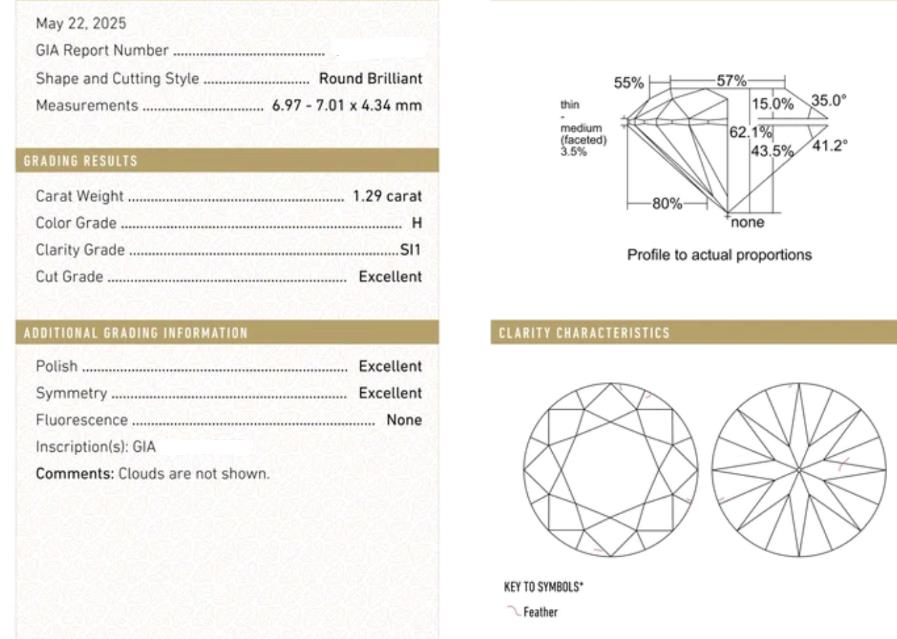
First, let’s go through its basic clarity grade. This stone is graded SI1. At first glance, SI1 can be a budget-friendly choice if the inclusions are tiny, few, and hidden out of sight. Its only listed inclusion type is feather, which sounds better than diamonds packed with dark mineral spots. Black crystals easily make a stone look dirty to the naked eye, while feathers only create faint white lines under light. This single inclusion type is its only small advantage, yet every other feature pulls its value down sharply.

The biggest safety flaw comes from the distribution of feathers. Many short feathers cluster all around the girdle. The girdle is the thinnest part of a diamond and bears constant pressure in daily wear. Prongs squeeze the girdle during setting, and small knocks against tables, walls or jewelry boxes hit this area often. Multiple feathers along the edge create dozens of weak stress points. Even light impact can stretch these cracks wider over time. If any of these girdle feathers reach the surface, the risk of chipping or splitting rises drastically. Repairs for cracked diamonds cost a lot, and severe splits ruin the stone permanently.
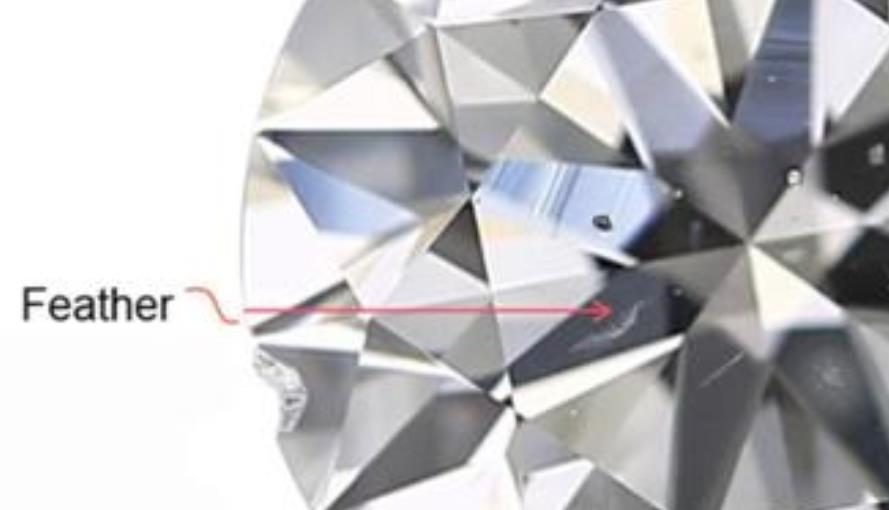
feather  blue nile

Second, there is one long feather in the pavilion that crosses two separate pavilion facets. The pavilion controls most of a diamond’s sparkle and light reflection. A long feather running across two facets forms a visible pale white streak when exposed to natural or indoor light. It blocks light travel inside the gem, cutting down brilliance and fire. Unlike tiny isolated feathers hidden at the culet, this extended crack covers a large reflective zone. Structurally, long cross-facet cracks transfer internal stress easily. A single hard bump may make the fracture spread deeper into the stone.

Another hidden problem sits in the certificate comment: clouds are not shown. This line means countless tiny cloud inclusions fill the diamond, and there are too many to mark on the clarity plot diagram. Clouds create a foggy, milky appearance inside diamonds. Instead of clear, crisp flashes of light, a stone with heavy clouds looks dull and hazy. This cloud mass is one key reason the diamond only reaches SI1 clarity; without these dense clouds, it would likely qualify for VS clarity. The white glow from feathers mixes with the milky haze from clouds, making the diamond look far less transparent than cleaner SI1 alternatives at the same price.

Now we weigh practical use and resale value. For daily-worn engagement rings or everyday jewelry, this stone is not reliable. Most buyers wear their rings nonstop while cooking, cleaning or moving around, which raises the chance of bumps and pressure. The combination of girdle feathers and a long pavilion crack makes it fragile. When it comes to resale, dealers strongly avoid stones with multiple feathers and heavy cloud coverage. Such diamonds lose far more value during trade-in than stones with minor, hidden inclusions.
Is This Blue Nile Diamond Worth Buying?

This diamond only barely works under two strict conditions. First, its price has to be at least 20 percent lower than comparable SI1 diamonds with clean inclusions. Second, the buyer plans to lock it in full bezel setting and wear it rarely, mainly for collection rather than daily use. For anyone looking for a durable, bright ring for regular wear, this option is not worth the investment.

A better standard for a good SI1 diamond on Blue Nile is clear. It should have one short internal feather away from the girdle, no cross-facet fractures, minimal tiny pinpoint inclusions, and no notes about unplotted clouds on the certificate. The clarity plot should show few marks, none touching the diamond’s outer edge. All in all, the layered flaws of clustered girdle feathers, a long pavilion cross-facet feather, and hidden dense clouds make this diamond a risky, low-sparkle pick that we do not recommend purchasing for daily wear.
Categories
Diamond Q&A

Blue Nile Diamond Review: Can You Pick a 1.51ct SI1 Stone With a Table Knot?

Not all diamonds are worth buying!!!
Both milky tint and brown hue:Tap to see full diamond info
This diamond has milky:Click view detailed diamond information
This diamond has green fluorescence.:View diamond details
This diamond has a cavity:See the diamond details

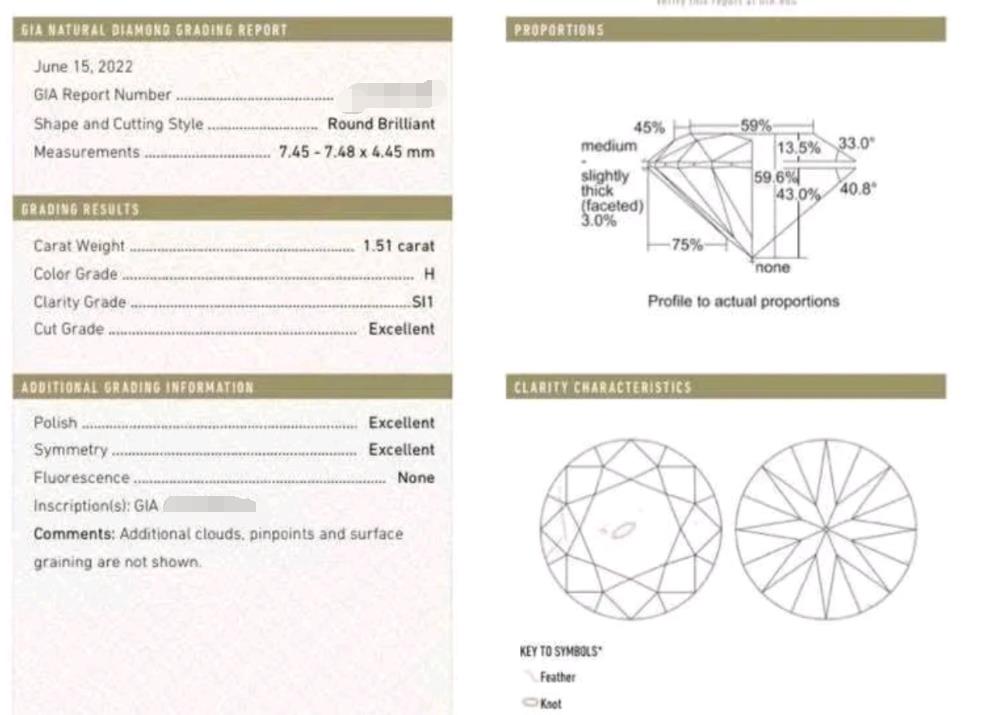
A reader sent me details of a 1.51-carat diamond listed on Blue Nile and asked whether it was worth buying. Below is its GIA certificate for reference. This stone weighs 1.51 carats with H color and SI1 clarity, featuring a perfect Triple Excellent cut and well-balanced proportions. Its 59% table percentage delivers outstanding brightness and sparkle. However, there is a prominent knot inclusion right at the center of the table, which is a critical drawback. Let’s break down the pros and cons of this diamond in detail.

Blue Nile Diamond Review: Can You Pick a 1.51ct SI1 Stone With a Table Knot?

Generally speaking, this 1.51-carat SI1 diamond with a prominent knot right on its table surface is not a wise pick, especially for an engagement ring. To begin with, a knot is classified as a serious internal inclusion formed by intergrown diamond crystals inside the stone. Its hardness differs from the surrounding diamond lattice, which creates hidden structural weaknesses and raises the risk of natural cracking under daily wear or minor impact. Worse still, this large knot sits at the center of the table, the most visible part of the diamond. When light hits the stone, the inclusion will appear as an obvious dark spot to the naked eye, ruining the stone’s transparency and brilliance and greatly diminishing its sparkling performance.

1.51ct SI1 Stone With a Table Knot

Although the diamond is graded SI1, this clarity grade only guarantees invisible blemishes on the condition that inclusions are tiny and placed near the girdle or pavilion. A noticeable central knot breaks this basic standard, making it one of the worst specimens within the SI1 range with poor overall value. At 1.5 carats, the diamond has a broad table area that magnifies every flaw, so the central knot will stand out prominently in daily use. It also suffers terrible resale value, as buyers will reject stones with obvious central inclusions during trade-in or resale.

The only acceptable scenario to consider this diamond is if you have an extremely tight budget, prioritize carat weight over visual beauty, and have no plans to resell or upgrade the stone in the future.

For most shoppers seeking a stunning, durable and retainable engagement diamond, try to opt for another SI1 stone with minor edge inclusions and no knots, or slightly raise your budget for a VS2 diamond with clean, unnoticeable internal features. Blue Nile carries a huge selection of high-quality loose diamonds with new stock refreshed on a regular basis. If you take time to browse its inventory frequently, you will constantly come across newly uploaded stones with cleaner clarity and superior cut performance. There is no need to settle for flawed options like the diamond we just discussed; with consistent updates, you can always find a far better diamond that matches your standards and budget, reach out to us to read more Blue Nile diamond reviews.

Categories
Diamond Q&A

Blue Nile GIA Certified Diamond Advice

Not all diamonds are worth buying!!!
Both milky tint and brown hue:Tap to see full diamond info
This diamond has milky:Click view detailed diamond information
This diamond has green fluorescence.:View diamond details
This diamond has a cavity:See the diamond details

Dialogue Between Diamond Inquirer & Diamond Consultant (ijadiamond)

Inquirer:

Hello there! I’d like to ask for your professional advice on two diamonds with distinct GIA certificate numbers of Blue nile: 7248194256 and 2257776455. Which one is the superior option overall? Besides, the diamond graded G color costs roughly an extra 600 US dollars compared to the H-color alternative. Also, should I only pick loose diamonds with zero fluorescence when purchasing unmounted stones?

ijadiamond:

I would recommend going for the diamond numbered 2257776455 without hesitation. Let me break down the flaws of the other stone for your reference. The diamond with serial number 7248194256 suffers from subpar cut quality, paired with a noticeably smaller girdle diameter. Visually, it fails to deliver a prominent, eye-catching presence when viewed with the naked eye. Theoretically speaking, its light performance and fire—the dazzling rainbow sparkle diamonds produce—will be noticeably weaker, making it far less cost-effective in contrast to the other option.
As for color grading differences, I suggest visiting physical jewelry stores to observe diamonds in natural daylight for comparison. From my practical experience, the visual gap between G and H color is barely distinguishable under natural light. For any diamond ranked H color or higher with no visible yellow tint, I strongly advise selecting a stone classified as non-fluorescent. Fluorescence can cloud a diamond’s clarity and brilliance under certain lighting conditions, so eliminating this factor avoids unexpected dullness.

Inquirer:

I’ve checked Blue Nile’s ring setting collections, and their design options feel quite limited. It took me ages to find one style I genuinely love, yet most of their bands are crafted from 14-karat gold. Could you also walk me through reliable ways to verify a diamond’s authenticity?

ijadiamond:

You’re absolutely right about Blue Nile’s aesthetic leanings; their ring styles are tailored primarily for Western consumers’ tastes. In terms of material durability, 14K gold is harder and more rigid than 18K gold, which translates to tighter, more secure stone setting that resists loosening over time. By contrast, most ring mounts available in Hong Kong jewelry shops use 18K gold, which contains a higher pure gold content for richer color and softer texture.
Every certified GIA diamond features a unique laser-inscribed serial number etched onto its girdle, matching the code printed on its corresponding GIA certificate. Even non-professional buyers can view this microscopic marking using a 20x magnifying loupe. This laser engraving acts as the diamond’s exclusive identification tag, serving as a primary authenticity check. For full, authoritative confirmation, you may also submit the stone to a certified third-party gemstone quality inspection laboratory for formal testing.

diamond advice

Inquirer:

Thank you so much for the detailed guidance! Could you share how to systematically pick a high-quality loose diamond?

ijadiamond:

The widely circulated strict diamond selection metrics online can act as valuable reference benchmarks, though they should not be treated as absolute rigid rules. Below are the standard acceptable ranges and tighter premium screening thresholds for key cutting parameters:
  1. Total Depth Percentage: Standard range 57.5%–63%; Premium selection window 60%–62%
  2. Table Percentage: Standard range 52%–62%; Premium selection window 55%–58%
  3. Crown Angle: Standard range 31.5°–36.5°; Premium selection window 34°–35°
  4. Crown Height Percentage: Standard range 12.5%–17%; Premium selection window 14%–16%
  5. Pavilion Angle: Standard range 40.4°–41.8°; Premium selection window 40.5°–41°
  6. Pavilion Depth Percentage: Standard range 42.5%–44.5%; Premium selection window 42.5%–43.5%
  7. Star Facet Length Percentage: Standard range 45%–65%; Premium selection window 55%–60%
  8. Lower Girdle Facet Percentage: Standard range 70%–85%; Premium selection window 70%–75%
  9. Girdle Thickness: Six official grades—Thin, Thin to Medium, Thin to Slightly Thick, Medium, Medium to Slightly Thick, Slightly Thick. Premium picks are limited to Thin to Medium, Medium, and Medium to Slightly Thick.
If you want to simulate and evaluate a diamond’s fire and light performance digitally, you can use this professional online HCA testing tool: https://www.pricescope.com/tools/hca

GIA diamond

Inquirer:

I followed the premium cut standards you shared to shortlist a diamond that I believe boasts excellent overall quality. Its GIA certificate ID is 7216278249. I ran the stone through the HCA test link you provided, and the generated score indicates outstanding light performance. Would you mind giving a second opinion on whether this diamond is a worthy purchase?

ijadiamond:

This diamond performs excellently across all critical cut, color, clarity and light performance metrics; it is a fantastic choice.

Inquirer:

Great, I will settle on this diamond then. I really appreciate all your patient advice!
Categories
Diamond Q&A

Blue Nile 1ct Diamond Selection & 4-Prong Ring Setting Consultation

Not all diamonds are worth buying!!!
Both milky tint and brown hue:Tap to see full diamond info
This diamond has milky:Click view detailed diamond information
This diamond has green fluorescence.:View diamond details
This diamond has a cavity:See the diamond details

Inquirer: Hello, your advice has been extremely helpful. I have a budget of no more than 60,000 Hong Kong Dollars, and I intend to purchase a 1-carat diamond from Blue Nile. My requirements for the stone are VS1 or VS2 clarity, G color or higher, and an excellent cut. I hope to pair it with a four-prong setting that maximizes the diamond’s visual size. Could you offer some suitable recommendations? Thank you very much.
Ijadiamond: Greetings. The following diamonds deliver outstanding value for money among stones with identical grading standards:
  1. Item No. 08722066
  2. Item No. 08705986
  3. Item No. 08656338
  4. Item No. 08452205
  5. Item No. 08739577
My top pick is the fifth stone. It boasts the finest cut and superior clarity grade. No prominent blemishes can be observed on its table facet under a 10x magnifying loupe, making it the most cost-effective option out of the five.
As for ring settings, you may consider style 197889. There is an alternative design, model 256699, which features slimmer shanks. Nevertheless, I would strongly suggest the first one. Crafted in 14k gold, it offers greater structural durability and better cost performance overall.
Inquirer: When it comes to wedding ring metal, which is the better choice, 18k gold or platinum?
Ijadiamond: Each metal carries distinct advantages. Platinum is marginally softer, rarer, and priced higher, while delivering a smoother, more comfortable wearing experience. In contrast, 18k gold provides firmer stone retention for diamond mounting. The vast majority of our diamond ring settings are made from 18k gold, with 14k designs only available in limited styles.
Inquirer: Why is diamond 08656338 priced significantly lower than the rest? Between diamond clarity and color, which factor holds greater priority?
Ijadiamond: Its GIA certificate records crystal inclusions on the stone’s table facet. It remains uncertain whether these flaws are visible to the naked eye upon physical inspection; visible eye-blemishes directly reduce the diamond’s market value. Clarity exerts a far larger impact on diamond pricing, while a G color grade is already a premium, visually neutral shade.
Inquirer: Please help me source an 18k gold four-prong setting instead. I want both thin prongs and a slim band. My partner has a delicate finger size 11, and my budget for the setting is capped at 6,000 Hong Kong Dollars.
Ijadiamond: Among our 18k gold ring mounts, style 57196 is an excellent match. It has a high-profile build that amplifies the diamond’s apparent size, with a small sapphire embedded beneath the stone as a unique, trendy decorative detail.

sapphire diamond ring blue nile

Categories
Diamond Q&A

Diamond Selection Advice for $2000 Budget on Blue Nile

Not all diamonds are worth buying!!!
Both milky tint and brown hue:Tap to see full diamond info
This diamond has milky:Click view detailed diamond information
This diamond has green fluorescence.:View diamond details
This diamond has a cavity:See the diamond details

Customer: Hello there. I am planning to purchase a diamond engagement ring recently. I have spent time learning the basic knowledge of the diamond 4Cs grading system and fundamental reading skills for GIA diamond certificates. I have browsed hundreds of loose diamond listings on Blue Nile’s Hong Kong website for quite a while, yet I feel totally overwhelmed by countless options now. My biggest worries are accidentally picking dull stones with obvious visible flaws that lack sparkle. More importantly, I am extremely concerned about purchasing milky, brown or green-tinted diamonds, commonly known as milk, coffee and green stones. These problematic visual traits cannot be filtered out through Blue Nile’s built-in parameter filters at all. Besides, I still lack professional know-how to thoroughly interpret every detail on a GIA certificate on my own. Could you offer me professional diamond selection guidance and help screen cost-effective loose stones that avoid all the above risks? I would really appreciate your professional advice.

Ijadiamond: Hi. I totally understand your concerns. Unfortunately, neither milky haze, brown/green tint nor eye-visible blemishes can be identified merely from GIA certificate data. All these undesirable optical features can only be judged by examining the physical diamond in person, which creates a natural limitation of online diamond shopping. Even though Blue Nile provides 40x magnified footage for every loose diamond listed, these digital materials still cannot fully replicate the true visual performance of the stone. Therefore, the standard and reliable solution is to shortlist qualified diamonds with ideal 4C parameters first, then submit the serial numbers to Blue Nile’s customer service team. You can ask their gemologists to manually inspect the actual diamond samples and confirm whether there are milky, brown or green undertones before you place an order. This double-check process effectively lowers your purchasing risks.

Customer: That makes perfect sense. My total budget is around 2,000 US dollars. Could you help me find a 0.6-carat round loose diamond with VS2 clarity or higher grading, alongside well-balanced table percentage, depth percentage and ideal proportion parameters for maximum light reflection? Thank you so much again for your patient guidance.

Ijadiamond: Take a look at this first option: https://www.bluenile.com/hk/diamond-details/LD08522774. It carries VS1 clarity, outperforming your minimum VS2 requirement, and all proportion metrics reach premium levels for outstanding brilliance. Another great alternative from Blue Nile’s inventory is this listing: https://www.bluenile.com/hk/diamond-details/LD08377103.

I also recommend one high-quality stone from James Allen, which has merged with Blue Nile under Signet Group: https://www.jamesallen.com/loose-diamonds/round-cut/0.66-carat-h-color-si1-clarity-excellent-cut-sku-2534596. Even though its clarity grade is SI1, the flawless stone is completely clean to the naked eye and boasts an Excellent cut that delivers exceptional fire and sparkle.

Customer: Thank you for the recommendations. How about this diamond I found earlier? It also looks pretty attractive to me: https://www.bluenile.com/hk/diamond-details/LD08727381

Ijadiamond: This loose stone is also a solid pick with a superior color grade compared to many similar options. The only downside is its price tag is slightly higher than your target budget range of $2,000.

Customer: Got it, I will compare all these four stones carefully and finalize my choice among them.

Ijadiamond: Wonderful choice! I am looking forward to seeing photos of your finished diamond ring once you receive it.

Categories
Diamond Q&A

Tips for Purchasing Blue Nile Round Diamond Within 1500 USD Budget

Not all diamonds are worth buying!!!
Both milky tint and brown hue:Tap to see full diamond info
This diamond has milky:Click view detailed diamond information
This diamond has green fluorescence.:View diamond details
This diamond has a cavity:See the diamond details

Inquirer: Hello, I’m planning to buy a loose round diamond from Blue Nile, and my budget is around 1,500 US dollars. I’m a total beginner with zero professional knowledge about diamonds, so I have no idea how to strike a proper balance among the four core diamond grading criteria, the 4Cs. One clear priority I have is that the diamond should not show an obvious yellow tint to the naked eye. I’d really appreciate it if you could offer me some targeted purchasing advice based on my limited budget and basic demand. Thank you so much in advance for your guidance.

Ijadiamond: Hi there, I’d recommend H color diamonds for you as they deliver outstanding cost performance with barely noticeable yellow undertones. When viewed with the naked eye, their visual appearance matches perfectly with H-color diamonds displayed in physical jewelry malls. You can visit offline jewelry stores to examine real H-color diamonds in person to help yourself decide whether this shade fits your aesthetic preference. As the old saying goes, scarcity boosts value; diamonds grow rarer as their carat weight increases. With your 1,500-dollar budget, you can afford a 0.70-carat diamond graded VVS in clarity, which will be completely eye-clean without any visible blemishes to ordinary observers.

I’ve shortlisted two round loose diamonds with superior cut quality and great value for money for your reference. Blue Nile provides highly detailed, crystal-clear real-shot videos and images of each loose diamond on its official website, which you can carefully review to inspect surface details. Before placing any order, remember to double-check whether the stone is fully eye-clean. You should also confirm it is free of milky or brown tint defects, commonly known as milk diamonds and coffee diamonds, which severely ruin a diamond’s sparkle and transparency. The two diamond links I mentioned are https://www.bluenile.com/hk/zh/diamond-details/LD08502199 and GIA 0.71 Carat H-VVS2 Excellent Cut Round Diamondrespectively. Unfortunately, the second link leads to an anti-bot verification page right now, so you may not access its diamond details temporarily.

Inquirer: Many thanks for your thoughtful and thorough suggestions. After comparing the two options you shared, I’ve made up my mind to go with the first diamond listed on Blue Nile.

Ijadiamond: You’re very welcome. Feel free to reach out if you have any other questions about diamond selection or order procedures later on.

Categories
Diamond Q&A

Recommend a one carat round diamond on Blue Nile

Not all diamonds are worth buying!!!
Both milky tint and brown hue:Tap to see full diamond info
This diamond has milky:Click view detailed diamond information
This diamond has green fluorescence.:View diamond details
This diamond has a cavity:See the diamond details

Hello there! The content you shared is really useful. I have a question for you. Which shape of diamonds from Blue Nile has the best fire? And which one looks the shiniest after being set into jewelry?
Hi! When a diamond has an ideal cut, round diamonds show much better fire than fancy-shaped diamonds. Diamond shape don’t have relation with brand. In the GIA certification system, only round diamonds get an official cut grade. The quality of cut plays a key role in a diamond’s fire and sparkle. A round diamond’s facets are arranged in perfect symmetry. It can fully reflect all light that goes inside the stone, and cast out bright colorful sparkles. Other fancy-shaped diamonds do not have such balanced and symmetrical cutting surfaces. That is why round diamonds always outperform fancy shapes when it comes to fire and brilliance.
Could you recommend a 1 carat white round diamond for me? I do not have strict rules on color, clarity or cut grades. But the stone must have no visible tint or flaws to the naked eye. I hope its reflection, sparkle and fire can be as great as possible. Also, I want the diamond to look larger on the ring after setting. My budget is within 3000 US dollars, and I can spend a little more if I find a really good piece. Thanks a lot!
Hello. I’d like to suggest one diamond with well-balanced parameters. It has a relatively large table surface. Its clarity grade is VS2 and color grade is J. The certificate marks there is a crystal inclusion on the table. We cannot tell the color of this crystal or whether it can be seen by eyes, so we need to send it to Blue Nile for further check. You can check details via this link: https://ijadiamond.com/bn/6978907
Another loose diamond is from James Allen, which has now merged with Blue Nile. This stone is G color and SI2 clarity. Even its clarity rank is not high, it looks totally clean to naked eyes. There are barely any noticeable blemishes on its table. All flaws cannot be seen directly. If it is not a milky diamond, this one is a nice pick. It has perfect cut and proportions, and meets all your demands. One thing to note is that milky diamonds will not be labeled on certificates, so you have to check the real stone in person. You can watch its 360-degree video through this link: https://ijadiamond.com/ja/194238
Alright, thank you so much for your advice and help. I finally pick the diamond from Blue Nile.
You are welcome. Do you have trouble picking a diamond? Feel free to contact us. You can learn more real reviews about Blue Nile by reaching out to us too.