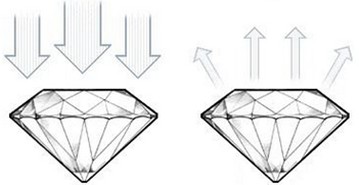
Not all diamonds are worth buying!!!
Both milky tint and brown hue:Tap to see full diamond info
This diamond has milky:Click view detailed diamond information
This diamond has green fluorescence.:View diamond details
This diamond has a cavity:See the diamond details
When we talk about diamond grading, the word Crystal stands for a common type of internal inclusion. In Chinese, people call it crystal inclusion. It is one of the most usual diamond flaws. Simply put, it is a tiny mineral crystal trapped inside a diamond during its formation. This small crystal get locked inside the stone millions of years ago. Crystal inclusions come in many shapes, such as cube, pinpoint, needle and cloud form. They also have different colors. Most are transparent or white, some are black, and colored ones are extremely rare.
Below is a quick guide showing different diamond inclusions, and Crystal is on the list.
Crystal: Tiny mineral crystals inside diamonds. Shapes include dots, needles, clouds and geometric forms. Mostly clear or black. It is the most common inclusion. Its size and position decide how much harm it does. Large black crystals badly hurt diamond clarity.
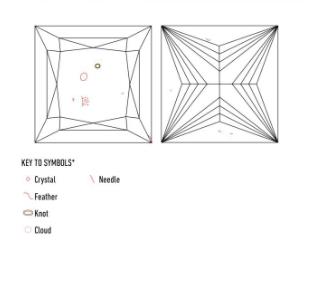
Pinpoint: Very small white crystal dots. They are tiny diamonds or other minerals. You need a magnifier to see them. They barely affect clarity.
Cloud: Groups of countless pinpoints. It looks like a hazy fog inside the stone. Big and dense clouds will lower the diamond’s transparency.
Feather: Internal cracks. It looks like feathers or thin lines. Large feathers or those near the edge will weak the diamond’s durability.
Needle: Long and thin crystal inclusions, just like small needles. Most are white and clear. They do little harm unless they are extra big.
Chip: Small nick on the girdle or surface. Caused by hitting or cutting. It ruins look and makes the stone less durable.
Now let’s learn more about crystal inclusions.
First, what do they look like? Clear or white crystals are the most common. They can be small pieces of diamond, olivine or garnet. Under 10x magnification, they look like small ice blocks or glass bits. Black crystals are usually graphite or dark minerals. They stand out more due to color contrast, so they damage clarity grade more than white ones.
Second, how do crystal inclusions affect diamonds? Diamond clarity grades range from FL, VVS, VS, SI to I. Graders judge clarity by the inclusion’s size, number, position and visibility. A big black crystal right under the table will pull down the clarity grade a lot.
For visual effect: Crystals in VS grade and above are super tiny. You can never see them with naked eyes. They do not affect beauty at all. Most crystals in SI grade are also invisible. Only a few big ones can be seen if you look closely from the side. SI diamonds have great value for money. Crystals in I grade are usually large or many in number. They are easy to spot, and will reduce the diamond’s transparency and brightness.
For durability: Most crystal inclusions do not make diamonds fragile. Only when the crystal is huge and connects with feather cracks, the stone will have safety risks.
Third, shopping tips for buyers. Do not chase totally flawless diamonds. Almost every natural diamond has inclusions, and crystal is the most ordinary one. If you have a limited budget, VS or SI grade is a smart pick, because their crystals cannot be seen by eyes.
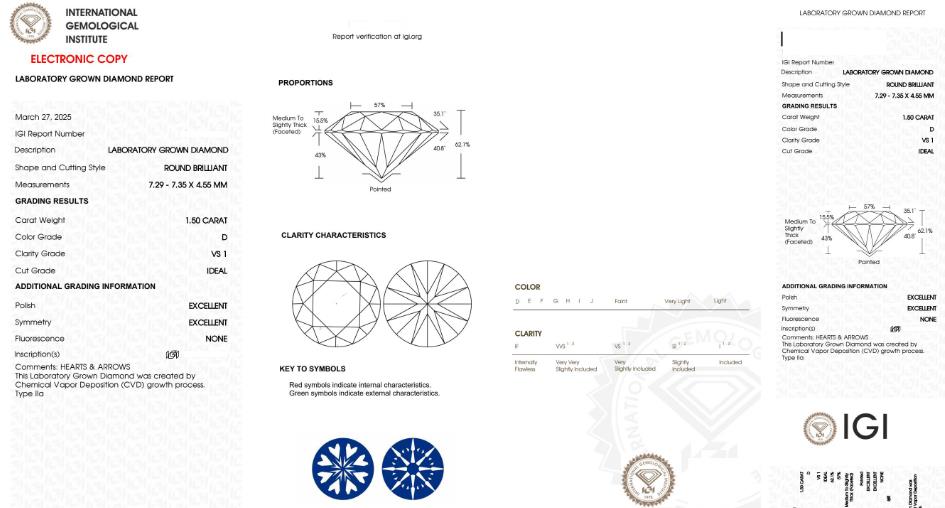
Always check official certificates. Labs like GIA and IGI draw clear clarity plots on reports. They mark the type and exact position of every inclusion including crystals.
Never trust certificates only. Check the diamond in person if you can, or ask the seller for high-definition videos. Make sure the crystal is invisible to naked eyes, especially for SI and I grade diamonds.
Pay attention to position. A crystal near the girdle is much better than one under the table. The setting can cover edge crystals easily.
Crystal is just a natural mark inside diamonds. As long as it is invisible, and the diamond has a reliable certificate, you can buy it without worry. These inclusions prove the diamond is natural, and there is no need to over concern.

和公主方切工(Princess-Cut)鑽石對比.jpg)