Not all diamonds are worth buying!!!
Both milky tint and brown hue:Tap to see full diamond info
This diamond has milky:Click view detailed diamond information
This diamond has green fluorescence.:View diamond details
This diamond has a cavity:See the diamond details
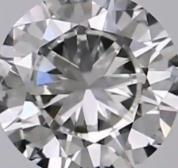
The name Flying Saucer Diamond is really vivid. It describes a diamond with an extremely shallow pavilion. When you look at it from the side, the girdle looks extra wide, while the pavilion part is extremely thin. The whole stone looks just like a flying saucer or a flat button.
This kind of cut has only one bad purpose. Cutters keep as much carat weight as they can, and make the table look much larger than it really is. It tricks buyers into thinking they get a big diamond. In diamond cutting industry, this is a clear negative term and a serious cut defect. It is also know as a worse version of fish eye diamond, or the extreme form of fish eye effect.
A flying saucer cut go against the core idea of diamond cutting. The goal of proper cutting is to maximize a diamond’s brilliance and fire. This bad cut brings many serious problems.
First, the diamond loss all brilliance and fire. It looks totally dull. A diamond shines because light enters the stone. The light reflect fully between pavilion facets, and finally bounce back through the crown to our eyes.
For flying saucer diamonds, the pavilion is too shallow. Light cannot reflect inside. It leaks straight out from the bottom. The stone turns dim and lifeless. It looks just like a plain piece of glass, with no sparkle at all. This is its biggest and worst flaw.
Second, it has obvious girdle reflection, also called severe fish eye effect. When you look down from the table, you will see a big, pale grey ring. This is the reflection of the thick girdle. The ring is large and clear. It makes the center of the diamond look empty and ugly. The whole stone lose its beauty completely.
Third, the structure is weak and easy to damage. The pavilion is super thin, so the girdle area become fragile. It is easy to get chips or cracks during setting or daily wear. This type of diamond has very poor durability.
How to spot a flying saucer diamond from a GIA certificate?
Do not only trust the overall cut grade. Some flying saucer diamonds can even get Good or Fair grade. You have to check the Proportions chart on the certificate carefully.
Pavilion Depth percentage is the most important index. If the number is below 40.0%, the risk is very high. A typical flying saucer diamond may have pavilion depth of 37% or even lower.
Total Depth percentage will also be too low. Total depth shows the full height of a diamond. Normal round diamonds have total depth between 57% and 63%. Flying saucer diamonds usually have total depth under 56%.
The Crown Angle is abnormal too. Cutters often use a very small crown angle to match the ultra-shallow pavilion.
The Girdle is extremely wide. The certificate marks girdle thickness. Most of these diamonds are marked Thick to Extremely Thick. Cutters barely polish the girdle, just to save weight.
Here is another easy way to judge. If both Pavilion Depth and Total Depth are unusually low, it is almost certainly a flying saucer diamond.
How to avoid buying this kind of diamond?
Learn to read the proportions on GIA reports. This is your first line of defense. Stay away from diamonds with pavilion depth below 40.0% and too low total depth.
Never buy a diamond only by its certificate. No matter how good the data is, check the real stone or watch 360° high-def videos from trusted sellers. Turn the diamond around. If you see a big grey ring on the table and no sparkle, do not buy it at all.
Choose reliable sellers. Pick well-known jewelry stores or online platforms, such as Blue Nile, James Allen( now belongs to Blue nile) and Whiteflash. They will filter out poorly cut diamonds in advance. They will not sell these bad stones to customers.