Not all diamonds are worth buying!!!
Both milky tint and brown hue:Tap to see full diamond info
This diamond has milky:Click view detailed diamond information
This diamond has green fluorescence.:View diamond details
This diamond has a cavity:See the diamond details
Needle inclusions are common features found inside natural diamonds. They get their name for a simple reason. They are thin, elongated crystal formations that look just like tiny sewing needles. These fine, thread-like inclusions form naturally during a diamond’s growth cycle. Minor stress and subtle distortions in the diamond’s crystal lattice create these slender structures.
Some needles are tiny stretched diamond crystals. Others contain trace minerals like rutile. They may also hold small mineral residues left over from the stone’s formation. You cannot spot them with the naked eye. They only become visible under 10x magnification. Under magnification, they show up as thin straight lines, soft curved streaks, or gentle wispy lines. Most needle inclusions are white or transparent. Dark-colored needles do exist, but they are less common.
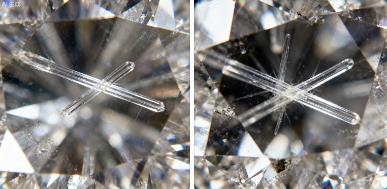
These inclusions do not affect all diamonds the same way. Their impact depends on four key factors: size, color, quantity, and placement. A single, small, faint needle causes almost no trouble. It is subtle and unnoticeable. It impacts clarity grade, appearance, and light performance very little. It is far less distracting than regular crystal inclusions or dark spots. It barely disrupts the diamond’s light transmission, brilliance, and fire.
The situation changes when needles are large, dark, or grouped together. Dark needles stand out sharply against clear diamond. They create strong visual contrast. Dense clusters of needles can even merge into cloud inclusions or twinning wisps. This noticeably lowers the diamond’s clarity rating. It scatters incoming light unevenly. The stone loses sparkle and visual brightness, which lowers its overall value. Location also matters a lot.
Needles sitting right below the table facet are highly visible. They catch the eye instantly. Needles near the diamond’s girdle stay hidden and unobtrusive.
Overall, needle inclusions are minor natural flaws in most cases. Scattered, tiny needles are harmless to diamond quality. They cannot be seen without tools. Interestingly, these unique internal marks are not always a downside. They give every diamond one-of-a-kind character. They act as natural proof of the stone’s genuine, unlab-grown formation.