Not all diamonds are worth buying!!!
Both milky tint and brown hue:Tap to see full diamond info
This diamond has milky:Click view detailed diamond information
This diamond has green fluorescence.:View diamond details
This diamond has a cavity:See the diamond details
Twinning Wisp is a standard term used on diamond grading reports, such as GIA certificates. It is a common natural growth feature inside diamonds, and it is also classified as one type of inclusion. Many people regard it as a regular diamond flaw. To help you fully understand twinning wisp, we will explain this feature in simple points below.
First, let’s talk about how twinning wisp form. Diamonds grow deep underground under extreme high temperature and high pressure. Their crystal structure cannot always grow in a perfect and continuous way. Sometimes the growth direction of crystal lattice will change suddenly, and then a twin crystal structure comes into being. Tiny impurities and other crystal defects may get trapped on the surface of this special structure. When these small substances connect together into lines or patches, a twinning wisp is created inside the diamond.
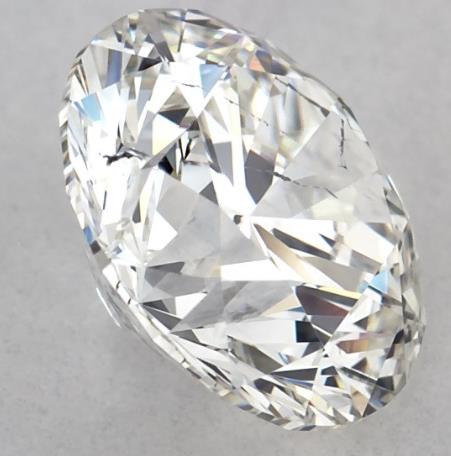
Next is the appearance of twinning wisp. When you look at it under a magnifying glass, you will see lines in white, off-white or transparent color. These lines can be straight, curved or even form a net shape. It never looks like a single small dot. Instead, it shows as thin lines or flat areas inside the stone.
Many buyers wonder: how does twinning wisp affect a diamond? We analyze the influences from three different parts.
The first part is the impact on clarity grade. Top grading labs like GIA clearly mark twinning wisp as an internal inclusion. Professional graders will check its size, quantity, visibility and position carefully. All these factors decide how much it affects the diamond’s final clarity grade. A small and faint twinning wisp will not cause big trouble for high clarity grades, such as VVS and VS. But if the lines are very obvious, or many wisps cross each other inside, the clarity grade will drop down to SI or even I level.
The second part is about durability risk, and this is the most important point you need to know. A twinning wisp is actually a weak zone in the diamond’s structure. If the wisp runs all the way to the girdle or the outer surface of the diamond, the stone will be much easier to crack along this weak line. The risk is higher during daily wearing or diamond setting work. Even professional diamond cutters face big trouble with twinning wisp. The stone is easy to split along the weak structure when cutting and polishing.
The third part is visual effect. In most cases, twinning wisp cannot be seen by naked eyes. You can only find them clearly under a 10x magnifier. Only in very rare cases, when twinning wisps are extremely dense inside, the diamond will look a little hazy. Just like milky diamonds, dense twinning wisps will reduce the stone’s transparency and fire.
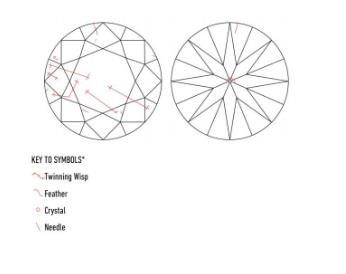
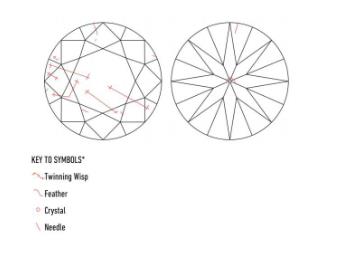
Now let us learn how twinning wisp is shown on a GIA certificate. On the clarity plot diagram of GIA report, twinning wisps are marked with red lines or red areas. Red color stands for internal features on standard grading drawings. The words “Twinning Wisp” will also be written in the notes section beside the diagram.
Here are some useful tips for all diamond customers:
Do not feel too worried about twinning wisp. It is a very common growth feature, and lots of natural diamonds have this inclusion. The key is to check the actual condition of the wisp, not just hear the name.
Learn to read your GIA certificate properly. You can trust the official clarity grade first. If the grade is SI1 or above, including VVS, VS and SI1, normally all inclusions like twinning wisp are invisible to naked eyes. They will not ruin the diamond’s beauty.
Checking the clarity plot is another key step. After you get the certificate, take time to look at the drawing carefully. If the red lines which mark twinning wisp reach the diamond’s edge or girdle, you must pay close attention to the durability risk. You can ask trusted sellers for more details about this stone.
Always choose shops with good reputation. Reliable jewelry sellers will pick out diamonds with serious structural risks in advance. They will also explain all internal features and possible influences to you honestly.
Do not reject a diamond just because it has twinning wisp. You need to judge a stone in all aspects. Cut is the most important factor for diamond sparkle, followed by color, carat weight and overall cost performance. A diamond with tiny twinning wisp but Excellent cut will shine much brighter than a totally clean diamond with poor cut quality.
To make a simple summary. Twinning wisp is a natural growth mark of diamonds. As a kind of inclusion, it will influence clarity grading. The biggest concern is whether the wisp locates near the edge, which may bring crack risks. You can judge the situation easily by reading the clarity plot on GIA certificate. With professional grading reports and trustworthy sellers, you can definitely pick out diamonds that are safe, beautiful and great value for money.