As the wedding day draws near, most ladies hope to own a big and shiny wedding diamond ring. As the flawless king of all gemstones, diamond is more than a symbol of loyal and exclusive love. To sort diamonds into different quality grades, GIA is a non-profit gemstone research institute based in United States. It devotes itself to offering professional gem education in jewelry industry, and it created the famous 4C standard to judge diamond quality. The four Cs stand for cut, clarity, color and carat of a diamond. If you wanna buy best quality diamonds with the lowest budget, you must fully understand what the 4C standards really means.
Cut
Diamond cut is the most important factor among all four Cs, and it’s also the only one that fully controlled by human hands. The quality of cut directly decides how sparkly a diamond can be. One thing people often mix up is that cut grade has nothing to do with diamond shape. A normal round brilliant diamond has three basic parts: crown, girdle and pavilion. Suppose two diamonds share same carat weight, same color grade and same clarity grade, but their cut grades differ a lot. Their market value will have a huge gap, this fully tells how powerful cut can affect diamond price.

Cut changes a diamond’s fire and sparkle directly, so it is a core judging rule of diamond 4C system. GIA split cut into five fixed grades, all printed clearly on official diamond certificates. GIA, short for Gemological Institute of America, release the most authoritative diamond grading certificates all over the world, it built a detailed full system to grade diamond cut. From top level to bottom, the ranks are Excellent, Very Good, Good, Fair and Poor. Diamond cutters polish stones follow fixed design proportions. Table percentage, pavilion depth ratio, pavilion angle and crown angle all together decide a diamond’s final cut grade. When all proportions hit perfect balance, the diamond will glow with amazing bright sparkles.
Poor cut: This grade cover all diamonds that fail standard cutting rules. Such stones usually have too wide pavilion or too deep body. Any light enters the diamond can easily leak out from its sides or bottom, so almost no light bounce back to people’s eyes.

Fair cut: Roughly 35 percent of all diamonds fall into this grade. Even though it look a little better than Poor cut stones, light refraction still can not reach ideal level. A large amount of light still escape without reflecting back.
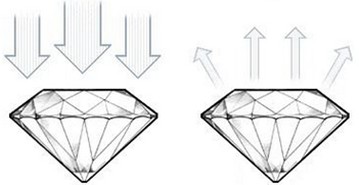
Good cut: This is high quality standard for diamond cutting. Around 25 percent diamonds get this grade. Most light that goes into the stone can reflect out through the top table surface successfully.

Very Good cut: About 15 percent of diamonds own this cut grade. Its fire and sparkle are almost same as Excellent cut diamonds. However, its selling price is much cheaper than top Excellent grade stones, so it got really good cost performance for regular buyers.

Excellent cut: It is the highest cut rank you can get. Only nearly 3 percent of natural diamonds reach this standard. It can reflect almost every ray of light that enters inside the stone, so diamonds of this grade always show outstanding bright fire.

Clarity
Diamond clarity describe how many internal
flaws a diamond carries. All clarity test work under 10x magnifying glass. Common flaw types include crystal inclusions, feather fractures, cloud marks, pinpoint spots and many other tiny marks. GIA sort clarity into eleven different grades, judging by inclusion’s size, total amount and their position inside the stone.
The full clarity rank list from top to low: FL (Flawless, no flaws at all), IF (Internally Flawless, only tiny surface marks exist, invisible to naked eyes), VVS1 (Very Very Slightly Included, ultra small inclusions, extremely hard to find without magnifier), VVS2 (Very Very Slightly Included, tiny inclusions, hard to spot by bare eyes), VS1 (Very Slightly Included, minor inclusions, almost impossible to see naked), VS2 (Very Slightly Included, small inclusions, hard to see without tools), SI1 (Slightly Included, small inclusions, invisible to human eyes), SI2 (Slightly Included, clear small
inclusions that naked eyes can catch), I1 and I2 (Included, obvious inclusions visible without magnifying glass), I3 (Included, huge obvious flaws easy to find with bare eyes at first sight).

Color
Diamond colors are mainly separated into three big series: fancy color diamond series, brown diamond series and Cape series. Fancy color diamonds contain stones with bright, vivid tone such as black, pink and green diamonds. Brown diamond series cover all shades of brown stones with different color saturation. The colorless to pale yellow diamonds people see everyday all belong to Cape series. In natural world, most raw natural diamonds fall into colorless to light yellow Cape range.
Letters D, E and F stand for pure colorless diamonds. G, H, I and J
grades are near colorless with almost unnoticeable yellow tint. K, L, M diamonds carry obvious light yellow tone. N through Z belong to stones with strong pale yellow color.

Carat
One carat equals 0.2 gram or 200 milligrams. This word comes from ancient Greek word keration. Carob tree seeds have steady uniform weight close to one
carat, so ancient people use these seeds as weight measuring tool for gemstones. One carat can split into 100 points, so a 40-point diamond equal to 0.4 carat. If a diamond’s cut, clarity and color grades are higher, the carat weight will create much bigger difference on its final market price.