Not all diamonds are worth buying!!!
Both milky tint and brown hue:Tap to see full diamond info
This diamond has milky:Click view detailed diamond information
This diamond has green fluorescence.:View diamond details
This diamond has a cavity:See the diamond details
Pinpoints are tiny white crystal inclusions inside diamonds. They form when the diamond traps small mineral crystals or tiny empty spaces during its growth. Common trapped minerals include other diamond crystals and garnets. When viewed under a 10x magnifying lens, these features look like tiny white dots, just like the tip of a needle. As the name suggests, they are dot-like inclusions.
Pinpoint is one of the most common inclusions found in diamonds. Diamonds of nearly all clarity grades may contain pinpoints. They are also among the mildest inclusions you can find. A single pinpoint barely affects a diamond’s look or value. Buyers do not need to worry too much about this feature. When shopping for diamonds, you should pay more attention to the overall clarity grade and whether the stone is transparent and brilliant.
How Do Pinpoints Affect Diamonds?
The impact of pinpoints depends entirely on their quantity, size and position inside the diamond.
Single small pinpoint
It has almost no negative effects. A lone tiny pinpoint is hard to spot even with a 10x magnifier.
In terms of clarity grade, a single pinpoint may drop a diamond from IF (Internally Flawless) to VVS1 or VVS2 (Very Very Slightly Included). These are still top-tier clarity levels.
To the naked eye, this kind of pinpoint is completely invisible. It will never ruin the diamond’s beauty or sparkle.
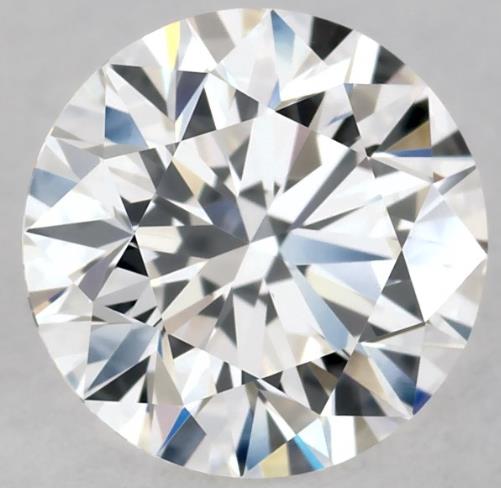
Clustered pinpoints
When three or more pinpoints gather closely together, they form another type of inclusion called a cloud. The area looks hazy and foggy.
If a cloud covers a large area and is very dense, the diamond will turn cloudy. People call this kind of stone a milky diamond. It will greatly reduce the diamond’s brightness and market value, so you need to watch out for this problem.
In most cases though, small clouds do not change the diamond’s appearance at all.
On the clarity plot of a GIA diamond report, pinpoints are marked with small red dots. Red marks stand for internal characteristics. If there are too many pinpoints to draw one by one, the report will add a note that says “Pinpoints are not shown”. This note means the diamond has a large number of tiny pinpoints. Gemologists will make a full evaluation of their total influence on clarity.
For most diamonds, pinpoints are harmless inclusions. One or several small pinpoints will not damage the diamond’s durability, nor will they affect its beauty during daily wear.
Even though pinpoints themselves are safe, you still need to check if they cluster into big clouds from the clarity diagram. If the report notes “Clouds are not shown”, you should ask the seller to check and make sure the diamond has no milky haze.
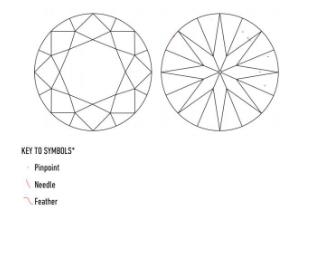
GIA clarity grading has already taken the influence of pinpoints into consideration. If a diamond is graded SI1 or higher, including FL, IF, VVS1, VVS2, VS1, VS2 and SI1, its pinpoints are almost impossible to see with naked eyes. If you can, it is always better to check the diamond in person.
Turn the diamond under light. If it looks clear, bright and free of foggy texture, you have no reason to worry about existing pinpoints.