Not all diamonds are worth buying!!!
Both milky tint and brown hue:Tap to see full diamond info
This diamond has milky:Click view detailed diamond information
This diamond has green fluorescence.:View diamond details
This diamond has a cavity:See the diamond details
If you plan to buy diamonds on Blue Nile, you will often spot a remark in the comments section of many GIA certificates that reads “additional pinpoints are not shown”. What exactly does this notation mean, and are diamonds carrying this marking worth purchasing?
You may also encounter other similar notes on Blue Nile diamond reports, such as “additional clouds are not shown” and “surface graining is not shown”. All these comments serve the same core purpose: they notify buyers that the diamond contains extra internal or surface blemishes that haven’t been plotted on the limited diagram area of the certificate.
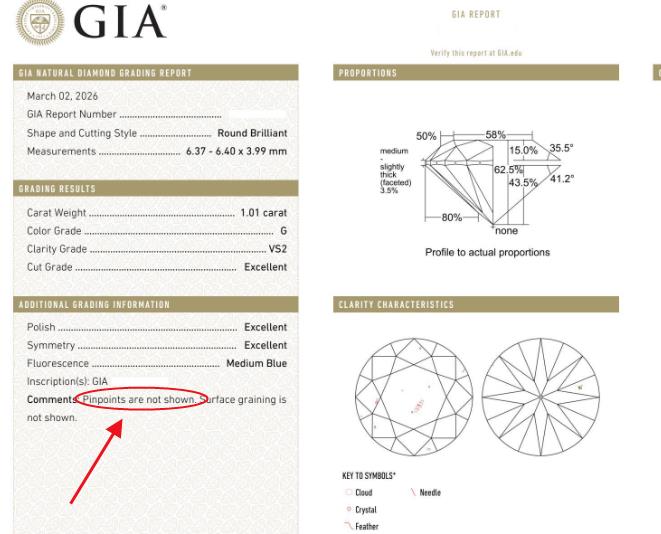
To start with, pinpoints are standard clarity terms defined by GIA, referring to tiny mineral speckles trapped inside natural diamonds during underground formation. These microscopic solid inclusions come in two types: colorless transparent pinpoints and dark black pinpoints, and they can only be observed clearly under a 10x gemological loupe, completely invisible to the naked eye. On the certificate’s plotting diagram, individual pinpoints are drawn as tiny dots, but when hundreds of these minuscule specks scatter throughout the stone, lab technicians cannot mark every single one on the limited sketch space, hence the supplementary note to inform buyers that numerous tiny pinpoints exist but remain unillustrated. It is critical to distinguish pinpoints from cloud, which are the primary culprit behind milky, hazy diamonds. Pinpoints exist as separate isolated dots and do not scatter light to create foggy dullness, while clouds are patchy flaky masses that block light transmission and ruin transparency. A diamond only marked with unshown pinpoints poses very low visual risks. Even dense clusters of pinpoints will not cause a milky appearance under natural daylight, nor will they weaken brilliance and fire, which is why VVS1 and VVS2 diamonds almost always carry this comment without any practical drawbacks for daily wear. The only minor downside is black pinpoints concentrated at the center of the table; though still invisible bare-eyed, they appear as tiny dark specks under magnification and slightly downgrade the stone’s visual quality. Caution is needed only when pinpoints coexist with prominent cloud inclusions. Combined dense pinpoints and cloud clusters boost internal impurity density, obstruct light penetration, and may lead to subtle haziness, especially for VS2 clarity stones. In terms of blue nile selection guidelines, VVS grade diamonds with this remark are totally acceptable. VS1 and VS2 stones with only pinpoints and zero clouds are safe choices, while those pairing clouds with unshown pinpoints should be approached carefully. For SI1 and SI2 diamonds, existing visible flaws make extra pinpoints negligible. Even top-color D-F diamonds with merely unmarked pinpoints will not turn gray or foggy outdoors.
When it comes to resale value, stones only noted for unshown pinpoints see minimal price cuts during recycling or second-hand trade, with roughly a 10% smaller discount compared to diamonds marked with unshown clouds and miscellaneous inclusions. In short, extra unillustrated pinpoints are harmless natural tiny blemishes that never create milky diamonds or dim sparkle. Clouds are the real hazard to watch out for. If you dislike abundant internal impurities, simply filter out stones with this comment; otherwise, you can confidently pick them without worrying about compromised light performance.